Directions in English: cómo dar y pedir direcciones en inglés
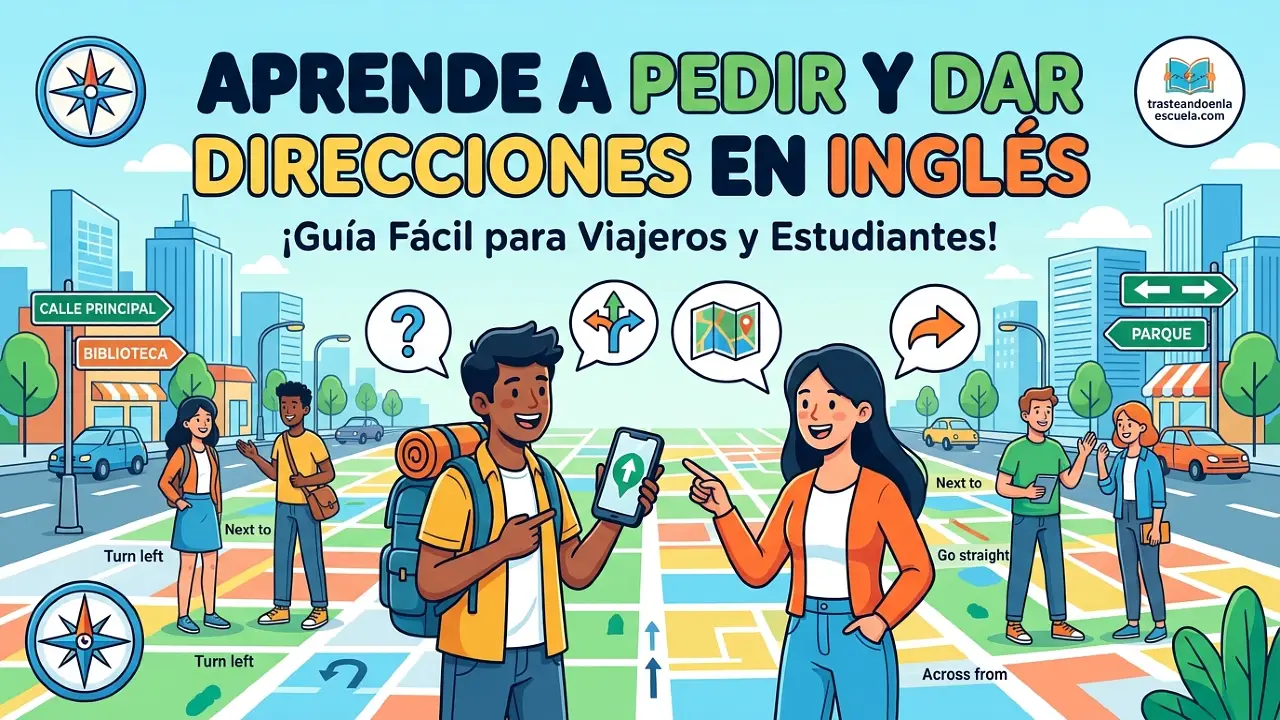
Directions in English: Cómo preguntar y dar direcciones en inglés (guía completa)
¿Alguna vez te has perdido en Londres, Nueva York o Sídney y no has sabido preguntar el camino? Saber dar y pedir direcciones en inglés es una habilidad esencial para viajar, estudiar o vivir en el extranjero. En este post aprenderás frases clave, preposiciones, verbos de movimiento, señales de tráfico, diferencias entre inglés británico y americano, diálogos reales y 8 ejercicios prácticos.
🎯 En este post aprenderás: Preguntas como Excuse me, where is the…?, órdenes como go straight, turn left, take the second right, preposiciones de lugar (opposite, next to, between, behind), puntos cardinales, vocabulario de señales urbanas, y todo lo necesario para no perderte nunca.
📋 Vocabulario básico para direcciones (más de 50 términos)
Aquí tienes la tabla más completa de palabras y frases para dar indicaciones, con pronunciación y ejemplos:
| Español | English | Pronunciación | Ejemplo |
|---|---|---|---|
| Sigue recto | Go straight (on) | góu stréit (on) | Go straight for two blocks. |
| Gira a la izquierda | Turn left | térn left | Turn left at the traffic lights. |
| Gira a la derecha | Turn right | térn rait | Turn right after the bank. |
| La primera calle a la derecha | Take the first right | téik de férst rait | Take the first right onto Main Street. |
| La segunda a la izquierda | Take the second left | téik de sé-kond left | Take the second left. |
| Cruza la calle | Cross the street | krós de stríit | Cross the street at the zebra crossing. |
| Sigue hasta… | Continue until… | kon-tí-niu an-tíl | Continue until you see the church. |
| Está en la esquina | It’s on the corner | its on de kór-ner | The pharmacy is on the corner of 5th and Main. |
| Está enfrente de | It’s opposite / across from | its ó-po-zit / a-krós from | The cinema is opposite the park. |
| Está al lado de | It’s next to | its nékst tu | The library is next to the bank. |
| Está entre | It’s between A and B | its bi-twín | The cafe is between the shop and the hotel. |
| Está detrás de | It’s behind | its bi-jáind | The car park is behind the supermarket. |
| Está delante de | It’s in front of | its in frant of | The statue is in front of the town hall. |
| Está cerca de | It’s near | its nir | Is there a tube station near here? |
| Está lejos de | It’s far from | its far from | The airport is far from the city centre. |
| Semáforo | traffic lights | trá-fik láits | Turn left at the traffic lights. |
| Esquina | corner | kór-ner | It’s on the corner. |
| Manzana (de casas) | block | blok | Go two blocks and turn right. |
| Paso de peatones (UK) | zebra crossing | zé-bra kró-sing | Cross at the zebra crossing. |
| Paso de peatones (US) | crosswalk | krós-wok | Use the crosswalk to cross the street. |
| Rotonda | roundabout (UK) / traffic circle (US) | ráun-da-baut / trá-fik sér-kel | At the roundabout, take the second exit. |
| Puente | bridge | brich | Cross the bridge and you’ll see the station. |
| Calzada | carriageway (UK) / roadway (US) | ká-ri-jwei / róu-dwei | Don’t walk on the carriageway. |
| Acera (UK) | pavement | péiv-ment | Walk on the pavement, not on the road. |
| Acera (US) | sidewalk | sáid-wok | The sidewalk is cracked. |
| Mapa | map | map | Can I see the map? |
| GPS / navegador | satnav (UK) / GPS (US) | sát-nav / yí-pi-és | Follow the satnav instructions. |
| Dirección | address | a-drés | What’s the address? |
| Punto de referencia | landmark | lánd-mark | Use the church as a landmark. |
| Norte | north | norz | Go north for one mile. |
| Sur | south | sauz | The station is south of the river. |
| Este | east | ist | Turn east at the junction. |
| Oeste | west | west | The museum is west of the park. |
💡 Puntos cardinales: En muchas ciudades americanas, las calles están numeradas y orientadas a los puntos cardinales. Por ejemplo: «It’s at 5th and Main, northeast corner». Aprender north, south, east, west te será muy útil.
🗣️ Frases para preguntar direcciones (20 ejemplos)
- Excuse me, where is the nearest bank, please? (Disculpe, ¿dónde está el banco más cercano?)
- How do I get to the train station? (¿Cómo llego a la estación de tren?)
- Is there a supermarket around here? (¿Hay un supermercado por aquí?)
- Which way is the museum? (¿Por dónde se va al museo?)
- Can you tell me the way to the post office? (¿Puede decirme el camino a la oficina de correos?)
- How far is it to the airport? (¿Qué distancia hay hasta el aeropuerto?)
- What’s the best way to get to the city centre? (¿Cuál es la mejor manera de llegar al centro?)
- Could you show me on the map? (¿Podría mostrármelo en el mapa?)
- Am I going the right way to the station? (¿Voy bien hacia la estación?)
- Is it within walking distance? (¿Está a distancia de caminar?)
- How long does it take on foot? (¿Cuánto se tarda a pie?)
- Which bus goes to the university? (¿Qué autobús va a la universidad?)
- Where is the nearest underground station? (¿Dónde está la estación de metro más cercana?)
- What’s the address of the hotel? (¿Cuál es la dirección del hotel?)
- Is there a signpost near here? (¿Hay una señal de tráfico cerca de aquí?)
🗣️ Frases para dar direcciones (25 ejemplos)
- Go straight on until you see a big church. (Sigue recto hasta que veas una iglesia grande.)
- Turn left at the traffic lights. (Gira a la izquierda en el semáforo.)
- Turn right at the roundabout. (Gira a la derecha en la rotonda.)
- Take the second right onto Green Street. (Coge la segunda calle a la derecha, en Green Street.)
- Take the first left after the bridge. (Coge la primera a la izquierda después del puente.)
- It’s on your left, next to the library. (Está a tu izquierda, al lado de la biblioteca.)
- You can’t miss it. It’s a tall yellow building. (No te lo puedes perder. Es un edificio alto amarillo.)
- It’s about a ten-minute walk from here. (Está a unos diez minutos a pie desde aquí.)
- Cross the street and you’ll see the bus stop. (Cruza la calle y verás la parada de autobús.)
- Continue straight for three blocks. (Continúa recto tres manzanas.)
- Go past the supermarket. (Pasa delante del supermercado.)
- The station is directly opposite the cinema. (La estación está justo enfrente del cine.)
- Head north on Main Street for half a mile. (Dirígete al norte por Main Street durante media milla.)
- Follow the signs for the city centre. (Sigue las señales hacia el centro de la ciudad.)
- It’s on the corner of 5th Avenue and 42nd Street. (Está en la esquina de la 5ª Avenida y la calle 42.)
- You’ll see a petrol station on your right. The hotel is just after that. (Verás una gasolinera a tu derecha. El hotel está justo después.)
- Don’t turn left. Keep going straight. (No gires a la izquierda. Sigue recto.)
- It’s behind the town hall. (Está detrás del ayuntamiento.)
- It’s between the bank and the post office. (Está entre el banco y la oficina de correos.)
- The entrance is on the side street. (La entrada está en la calle lateral.)
🎧 Diálogo completo 1: Preguntando direcciones en la calle (UK)
Tourist: Excuse me, could you tell me how to get to the British Museum?
Local: Yes, of course. Go straight on for about 200 metres. You’ll see a large square. Turn left at the square, then take the second street on your right. The museum will be on your left, next to a park.
Tourist: Is it far from here?
Local: No, it’s about a ten-minute walk. You can’t miss it.
Tourist: Thank you very much!
Local: You’re welcome. Enjoy your visit!
🎧 Diálogo completo 2: En una ciudad americana (US)
Visitor: Excuse me, where is the nearest subway station?
Local: Walk two blocks north on this street. Then turn right at the traffic lights. The station is on the corner, across from a Starbucks.
Visitor: How long does it take?
Local: About five minutes.
Visitor: Great. And which train goes to Times Square?
Local: Take the downtown 1 train. It’s the red line.
Visitor: Thanks a lot!
Local: No problem.
📊 Diferencias entre inglés británico y americano (direcciones y señales)
| Español | Reino Unido (UK) | Estados Unidos (US) |
|---|---|---|
| Acera | pavement | sidewalk |
| Calzada | carriageway | roadway |
| Paso de peatones | zebra crossing | crosswalk |
| Rotonda | roundabout | traffic circle / rotary |
| Semáforo | traffic lights | traffic lights / stoplight |
| Calle principal | high street | main street |
| Centro de la ciudad | city centre / town centre | downtown |
| Mapa | map | map |
| Dirección (señal) | signpost | sign |
| Gasolinera | petrol station | gas station |
| Autopista | motorway | highway / freeway |
| Billete (transporte) | ticket | ticket |
| Ida y vuelta | return ticket | round-trip ticket |
⚠️ Atención: En Reino Unido, «pavement» es la acera; en Estados Unidos, «pavement» es el pavimento de la carretera en general. Si dices «walk on the pavement» en EEUU, podrían pensar que caminas sobre la calzada. Mejor usa «sidewalk».
🧠 8 ejercicios prácticos para dominar las direcciones
Ejercicio 1: Relaciona cada frase con su significado en español.
- Go straight ahead → a) Gira a la izquierda
- Turn right → b) Sigue recto
- Take the first left → c) Cruza la calle
- Cross the street → d) Gira a la derecha
- It’s opposite the bank → e) Está enfrente del banco
- It’s next to the library → f) Está al lado de la biblioteca
✅ Solución
1-b, 2-d, 3-a, 4-c, 5-e, 6-fEjercicio 2: Completa las direcciones con las palabras adecuadas (straight, left, right, corner, opposite, next to, between, behind).
- Go _______ on for two blocks. (straight)
- Turn _______ at the traffic lights. (left/right)
- The hotel is on the _______ of Main Street and 2nd Avenue. (corner)
- The cinema is _______ the park (enfrente). (opposite)
- The library is _______ the bank (al lado). (next to)
- The cafe is _______ the bank and the bookshop (entre). (between)
- The car park is _______ the supermarket (detrás). (behind)
✅ Solución
a) straight, b) left/right, c) corner, d) opposite, e) next to, f) between, g) behindEjercicio 3: Ordena las palabras para formar preguntas correctas.
- the / station / is / Where / train / ?
- to / get / I / How / do / the / square / ?
- near / a / Is / here / there / pharmacy / ?
- far / it / How / to / the / is / airport / ?
- way / the / Which / is / to / the / museum / ?
✅ Solución
a) Where is the train station?b) How do I get to the square?
c) Is there a pharmacy near here?
d) How far is it to the airport?
e) Which way is the museum?
Ejercicio 4: Escribe las direcciones que escucharías para ir desde el punto A al punto B (imaginario).
Inventa un mapa mental: Desde la biblioteca hasta el parque. Usa al menos 4 instrucciones (go straight, turn left/right, go past, etc.).
✅ Ejemplo de respuesta
Go straight from the library. Turn left at the traffic lights. Walk two blocks. Go past the school. The park is on your right, opposite the church.Ejercicio 5: Traduce las siguientes indicaciones al inglés.
- Sigue recto hasta el semáforo.
- Gira a la derecha en la iglesia.
- Coge la primera calle a la izquierda.
- Está en la esquina, al lado de la farmacia.
- Cruza la calle y sigue dos manzanas.
- La estación está enfrente del cine.
- El banco está entre la biblioteca y el supermercado.
✅ Solución
a) Go straight to the traffic lights.b) Turn right at the church.
c) Take the first left.
d) It’s on the corner, next to the pharmacy.
e) Cross the street and go two blocks.
f) The station is opposite the cinema.
g) The bank is between the library and the supermarket.
Ejercicio 6: Elige la opción correcta (UK vs US).
- In London, you walk on the __________. (pavement / sidewalk) → pavement
- In New York, you cross the street at the __________. (zebra crossing / crosswalk) → crosswalk
- In the UK, a __________ is a circular junction. (roundabout / traffic circle) → roundabout
- In the US, the city centre is often called __________. (downtown / high street) → downtown
- You need to put petrol in your car. In the US you go to a __________. (petrol station / gas station) → gas station
✅ Solución
a) pavement, b) crosswalk, c) roundabout, d) downtown, e) gas stationEjercicio 7: Completa el diálogo con las palabras del recuadro (straight, left, right, opposite, next, corner).
Anna: Excuse me, how do I get to the museum?
Mark: Go _______ (1) on until you see a big square. Turn _______ (2) at the square. Then take the first _______ (3). The museum is _______ (4) the bank, _______ (5) to the library. It’s on the _______ (6) of Main Street.
✅ Solución
1) straight, 2) left, 3) right, 4) opposite, 5) next, 6) cornerEjercicio 8: Escribe 5 frases dando direcciones desde tu casa hasta un lugar cercano (supermercado, parque, estación, etc.). Usa al menos 5 expresiones de las aprendidas.
✅ Ejemplo de respuesta
- Go straight from my house for two blocks.
- Turn left at the traffic lights.
- Walk past the school.
- Take the first right after the bridge.
- The supermarket is on your left, opposite the post office.
- It’s about a five-minute walk.
🌍 Señales de tráfico y carteles comunes en inglés
- STOP – Alto / Pare
- GIVE WAY (UK) / YIELD (US) – Ceda el paso
- NO ENTRY – Prohibido el paso
- ONE WAY – Dirección única
- DO NOT ENTER – No entrar
- PEDESTRIAN CROSSING – Paso de peatones
- SCHOOL ZONE – Zona escolar
- SPEED LIMIT 30 – Límite de velocidad 30
- NO PARKING – Prohibido aparcar
- TOWN CENTRE (UK) / DOWNTOWN (US) – Centro ciudad
- RING ROAD (UK) / BELTWAY (US) – Circunvalación
- DEAD END (UK) / NO OUTLET (US) – Calle sin salida
📖 Glosario adicional para no perderse
- Landmark – punto de referencia (un edificio o monumento conocido).
- Junction – cruce / intersección.
- Intersection – intersección (más común en EEUU).
- Crossroads – cruce de caminos.
- Roundabout exit – salida de una rotonda.
- One-way street – calle de sentido único.
- Dual carriageway (UK) / divided highway (US) – carretera de doble calzada.
- Footpath – sendero peatonal.
- Underpass – paso subterráneo (peatonal).
- Overpass / flyover – paso elevado.
- Tunnel – túnel.
- Signpost – poste indicador.
📚 Más temas de la ciudad en inglés
- Places in town: lugares de la ciudad – Vocabulario general.
- Shops: tiendas en inglés – Aprende los nombres de todas las tiendas.
- Transport: medios de transporte – Para moverte.
- Buildings: edificios públicos – Hospital, biblioteca, museo…



Publicar comentario