Transport in English: medios de transporte en inglés con ejemplos
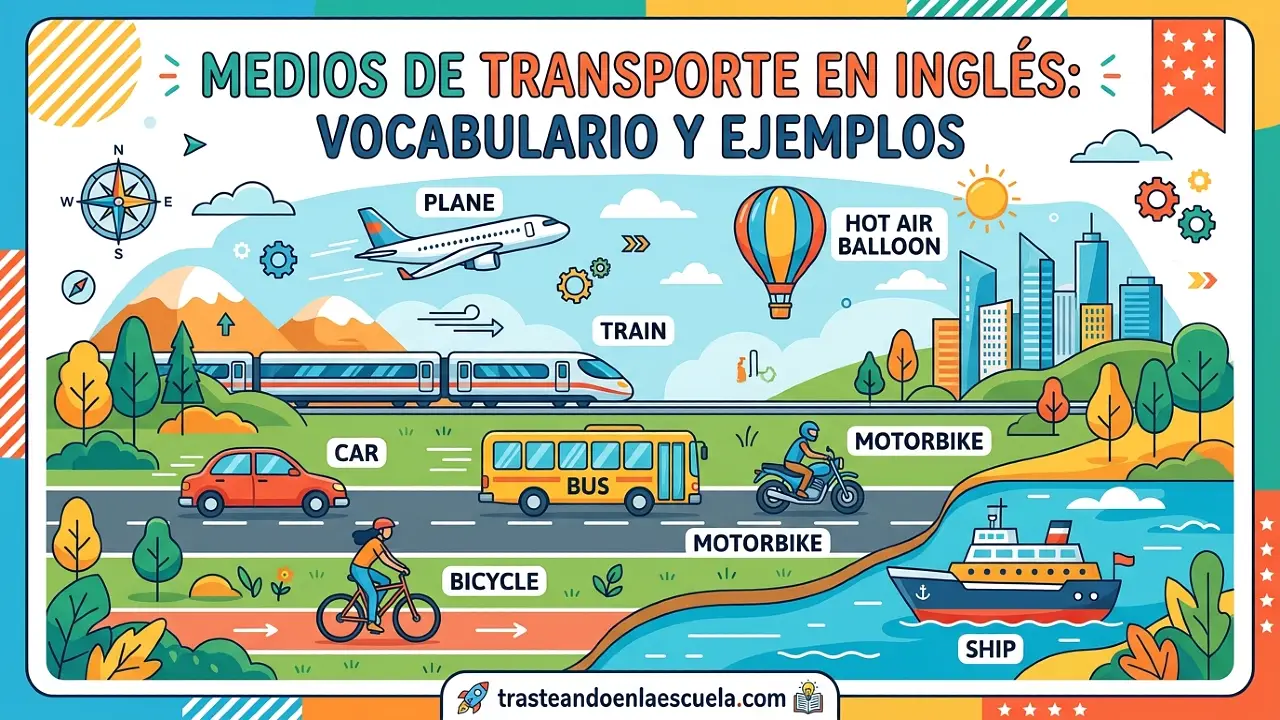
Transport in English: Todos los medios de transporte en inglés (guía completa)
¿Vas en coche, en autobús, en tren o en bicicleta? Para describir cómo te mueves por la ciudad o planificar un viaje necesitas conocer el vocabulario de los means of transport (medios de transporte). En este post te enseñamos desde los vehículos más comunes hasta las preposiciones y verbos correctos para cada uno, con pronunciación, diferencias entre inglés británico y americano, diálogos reales y 8 ejercicios prácticos.
🎯 En este post aprenderás: Más de 40 medios de transporte, la diferencia entre by car / in the car, los verbos drive, ride, take, get on/off, expresiones idiomáticas relacionadas con el transporte, y todo lo necesario para moverte con soltura en un país angloparlante.
📋 Clasificación de transportes por tipo (terrestre, aéreo, marítimo)
🚙 Transporte terrestre (road and rail transport)
Incluye vehículos que se desplazan por carretera o vías férreas. Aquí tienes la tabla más completa:
| Español | English | Pronunciación | Verbo típico | Ejemplo |
|---|---|---|---|---|
| Coche | car | kar | drive | I drive my car to work every day. |
| Autobús (urbano) | bus | bas | take / ride | She takes the bus to school. |
| Autocar (larga distancia) | coach (UK) / long-distance bus (US) | kouch | take | We took a coach from London to Edinburgh. |
| Motocicleta | motorbike / motorcycle | móu-ter-baik | ride | He rides his motorbike every weekend. |
| Bicicleta | bicycle / bike | bái-si-kel / baik | ride | I ride my bike to the park. |
| Patinete eléctrico | electric scooter | i-lék-trik skú-ter | ride | Electric scooters are popular in big cities. |
| Taxi | taxi / cab | ták-si / kab | take / get in | Let’s take a taxi to the airport. |
| Camiones | lorry (UK) / truck (US) | ló-ri / trak | drive | My uncle drives a lorry. |
| Furgoneta | van | van | drive | We rented a van to move the furniture. |
| Tranvía | tram (UK) / streetcar (US) | tram / strít-kar | take | You can take the tram to the city centre. |
| Metro | underground (UK) / subway (US) / metro | án-der-graund / sáb-wei | take | I take the underground to work. |
| Tren | train | tréin | take | The train to Manchester leaves at 9am. |
| Tren de cercanías | commuter train | ko-miú-ter tréin | take | I take the commuter train every morning. |
| Tren de alta velocidad | high-speed train | jái-spíd tréin | take | The high-speed train goes from Madrid to Barcelona in 2.5 hours. |
| Andén (tren/metro) | platform | plát-fórm | wait on | Your train leaves from platform 3. |
| Vía (de tren) | track | trak | – | Be careful, the train is on track 2. |
✈️ Transporte aéreo (air transport)
| Español | English | Pronunciación | Verbo típico | Ejemplo |
|---|---|---|---|---|
| Avión | plane / aeroplane (UK) / airplane (US) | pléin / ér-o-pléin | fly / take | We flew to New York by plane. |
| Helicóptero | helicopter | jé-li-cóp-ter | fly | The helicopter landed on the roof. |
| Aeropuerto | airport | ér-port | go to | We arrived at the airport two hours early. |
| Vuelo | flight | fláit | catch / take | We caught an early flight to Paris. |
| Puerta de embarque | gate | gueit | go to | Your flight departs from gate B12. |
| Avioneta | small plane / light aircraft | smol pléin / láit ér-kraft | fly | He learned to fly a light aircraft. |
⛴️ Transporte marítimo y fluvial (water transport)
| Español | English | Pronunciación | Verbo típico | Ejemplo |
|---|---|---|---|---|
| Barco | boat | bout | sail / take | We took a boat trip along the river. |
| Ferry / transbordador | ferry | fé-ri | take | We took the ferry from Dover to Calais. |
| Crucero | cruise ship | krús ship | go on a cruise | They went on a cruise around the Caribbean. |
| Puerto | port / harbour | port / jár-ber | arrive at | The ship is in the harbour. |
| Velero | sailboat (US) / sailing boat (UK) | séil-bout | sail | They have a small sailboat on the lake. |
| Lancha motora | speedboat | spíd-bout | drive | The speedboat is very fast. |
💡 Preposiciones clave con medios de transporte:
– By + medio de transporte (by car, by bus, by plane) para indicar el modo de viaje en general.
– On + transporte público (on the bus, on the train, on the plane).
– In + vehículo cerrado (in the car, in the taxi).
– On foot (a pie) – ¡ojo! no se dice «by foot».
– Get on / get off para autobús, tren, avión, bicicleta.
– Get in / get out of para coche, taxi.
🗣️ Verbos y expresiones esenciales para viajar (más de 30 ejemplos)
🚦 Cómo decir que usas un transporte (verbos principales)
- Take + transport (take the bus, take the train, take a taxi, take a flight) – muy común.
- Ride + bike / motorbike / horse (ride a bike, ride a motorbike).
- Drive + car / lorry / van (drive a car, drive a truck).
- Fly + plane / helicopter (fly to London, fly a helicopter).
- Go by + transport (go by car, go by bus, go by plane).
- Walk / go on foot (ir andando).
- Catch + transport (catch the train, catch the bus, catch a flight).
🚏 Subir y bajar (get on / get off / get in / get out of)
- Get on – subir a (bus, train, plane, bike, horse). Ej: Get on the bus at the front.
- Get off – bajar de (bus, train, plane, bike). Ej: Get off at the next stop.
- Get in – entrar en (car, taxi). Ej: Get in the car, we’re leaving.
- Get out of – salir de (car, taxi). Ej: Get out of the taxi when we arrive.
🗺️ Frases útiles para viajar
- What time does the next bus leave? (¿A qué hora sale el próximo autobús?)
- Which platform does the train to London depart from? (¿De qué andén sale el tren a Londres?)
- How much is a single ticket to Manchester? (¿Cuánto cuesta un billete sencillo a Manchester?)
- Is this seat taken? (¿Está ocupado este asiento?)
- I’d like a window seat, please. (Quisiera un asiento de ventanilla, por favor.)
- Do I need to change trains? (¿Necesito cambiar de tren?)
- How long does the journey take? (¿Cuánto dura el viaje?)
- Where can I buy a ticket? (¿Dónde puedo comprar un billete?)
🎧 Diálogo completo: En la estación de tren (At the train station)
Passenger: Excuse me, what time is the next train to Brighton?
Ticket officer: The next train departs at 10:15 from platform 5.
Passenger: How much is a return ticket?
Ticket officer: £32. Single is £18.
Passenger: I’ll take a return, please. Can I pay by card?
Ticket officer: Yes, of course. Here’s your ticket. The train is on time.
Passenger: Thank you. Which way is platform 5?
Ticket officer: Go straight, then turn left. It’s next to the cafe.
Passenger: Great. Thanks again!
📊 Tabla comparativa: Reino Unido vs Estados Unidos (transporte)
| Español | Reino Unido (UK) | Estados Unidos (US) |
|---|---|---|
| Metro | underground / tube | subway |
| Autocar (larga distancia) | coach | long-distance bus |
| Tranvía | tram | streetcar / trolley |
| Camión | lorry | truck |
| Acera | pavement | sidewalk |
| Calzada | carriageway | roadway |
| Rotonda | roundabout | traffic circle |
| Semáforo | traffic lights | traffic lights (same) |
| Paso de peatones | zebra crossing | crosswalk |
| Billete (sencillo) | single ticket | one-way ticket |
| Billete (ida y vuelta) | return ticket | round-trip ticket |
| Equipaje | luggage | baggage |
| Maletero (coche) | boot | trunk |
| Capó (coche) | bonnet | hood |
⚠️ Falsos amigos y precauciones: En inglés británico, boot es el maletero del coche; en informática, boot es arrancar. En inglés americano, subway es el metro, no un paso subterráneo peatonal (eso es underpass). Y recuerda: gas en EEUU es gasolina; en UK se dice petrol.
🧠 8 ejercicios prácticos para dominar el transporte
Ejercicio 1: Elige la opción correcta (preposiciones y verbos).
- I usually go to work ______ car. (by)
- She goes everywhere ______ foot. (on)
- We need to ______ a taxi to the airport. (take)
- He is sitting ______ the car. (in)
- Get ______ the bus at the next stop. (on)
- Please get ______ the taxi – we’re in a hurry. (in)
- I prefer to travel ______ train rather than by car. (by)
✅ Solución
a) by, b) on, c) take, d) in, e) on, f) in, g) byEjercicio 2: Traduce las frases al inglés.
- Voy al trabajo en bicicleta.
- Ella prefiere viajar en tren.
- ¿Cómo llego a la estación? – Anda 10 minutos.
- Mi padre conduce un camión.
- Subimos al avión a las 8.
- ¿A qué hora sale el próximo autobús?
- ¿Cuánto cuesta un billete de ida y vuelta a Londres?
✅ Solución
a) I go to work by bike. / I ride my bike to work.b) She prefers to travel by train.
c) How do I get to the station? – Walk for 10 minutes / Go on foot.
d) My father drives a lorry/truck.
e) We get on the plane at 8.
f) What time does the next bus leave?
g) How much is a return ticket (UK) / round-trip ticket (US) to London?
Ejercicio 3: Completa con el verbo correcto (take, ride, drive, get on, get off, catch).
- I usually ______ the bus to school. (take)
- Can you ______ a motorbike? (ride)
- Please ______ the car carefully. (drive)
- We ______ the train at platform 3. (get on)
- You need to ______ at the next stop. (get off)
- We need to ______ a flight to Paris. (catch)
- She ______ her bike to the library. (rides)
✅ Solución
a) take, b) ride, c) drive, d) get on, e) get off, f) catch, g) ridesEjercicio 4: Verdadero o falso (corrige los falsos).
- A «ferry» is a type of plane. (False – it’s a boat)
- «Underground» and «subway» mean the same. (True)
- You «drive» a bicycle. (False – you ride a bicycle)
- A «coach» is a luxury car. (False – a coach is a long-distance bus)
- You «get in» a taxi. (True)
- You «get off» a car. (False – you get out of a car)
- In the US, «truck» is the same as UK «lorry». (True)
✅ Solución
a) F, b) T, c) F, d) F, e) T, f) F, g) TEjercicio 5: Ordena las palabras para formar frases correctas.
- go / I / by / usually / bus / to / school / .
- does / What / time / train / the / leave / ?
- get / the / at / off / next / stop / .
- to / need / a / We / taxi / take / the / airport / .
- prefer / I / travel / by / train / .
✅ Solución
a) I usually go to school by bus.b) What time does the train leave?
c) Get off at the next stop.
d) We need to take a taxi to the airport.
e) I prefer to travel by train.
Ejercicio 6: Elige la palabra correcta (UK vs US).
- In London, you take the __________ to go quickly around the city. (underground / subway) → underground
- In New York, you call it the __________. (subway / tube) → subway
- My father drives a big __________. (lorry / truck) – ambas correctas, pero depende del país.
- I need to put my suitcase in the __________ of the car. (boot / trunk) – boot (UK), trunk (US)
- We bought a __________ ticket to return next week. (return / round-trip) – return (UK), round-trip (US)
✅ Solución
a) underground, b) subway, c) lorry (UK) / truck (US), d) boot (UK) / trunk (US), e) return (UK) / round-trip (US)Ejercicio 7: Describe tu viaje diario al trabajo/escuela usando al menos 5 medios de transporte o verbos. (Escribe 5-7 frases)
✅ Ejemplo de respuesta
I live near my school, so I usually go on foot. Sometimes I take the bus when it rains. My father goes to work by car. On weekends, we ride our bikes to the park. Last summer we flew to Italy. At the airport, we took a taxi to the hotel. I love travelling by train because it’s comfortable.Ejercicio 8: Completa el diálogo con las palabras del recuadro (platform, ticket, train, leave, get on, return).
Tom: Excuse me, what time does the next ______ (1) to Manchester ______ (2)?
Clerk: At 11:30 from ______ (3) 2.
Tom: How much is a ______ (4) ticket?
Clerk: £45. Here’s your ______ (5). You need to ______ (6) the train now.
Tom: Thanks!
✅ Solución
1) train, 2) leave, 3) platform, 4) return, 5) ticket, 6) get on🌍 Expresiones idiomáticas relacionadas con el transporte
- Miss the boat – perder una oportunidad. Ej: I missed the boat on that job offer.
- Drive someone crazy – volver loco a alguien. Ej: This noise is driving me crazy.
- Hit the road – ponerse en camino. Ej: Let’s hit the road before it gets dark.
- Backseat driver – persona que da órdenes sin tener autoridad. Ej: Stop being a backseat driver!
- On the right track – ir por buen camino (en sentido figurado). Ej: Your project is on the right track.
- As the crow flies – en línea recta. Ej: It’s only 5 km as the crow flies, but 10 km by road.
- Put the brakes on something – frenar algo. Ej: The company put the brakes on the new project.
📖 Glosario adicional (términos de transporte avanzados)
- Commuter – viajero que va diariamente al trabajo/estudio.
- Peak hour / rush hour – hora punta.
- Off-peak – fuera de horas punta.
- Single-decker bus – autobús de un piso.
- Double-decker bus – autobús de dos pisos (típico de Londres).
- Overnight train – tren nocturno.
- Departure board – panel de salidas.
- Arrival board – panel de llegadas.
- Delay – retraso.
- Cancellation – cancelación.
- Platform ticket – billete de andén (solo para acceder al andén).
📚 Más vocabulario de la ciudad en inglés
- Places in town: lugares de la ciudad – Vocabulario general.
- Shops: tiendas en inglés – Aprende los nombres de todas las tiendas.
- Buildings: edificios públicos – Hospital, biblioteca, museo…
- Directions: direcciones y preposiciones – Cómo preguntar y dar indicaciones.








Publicar comentario