Phrasal verbs separables vs inseparables: reglas definitivas
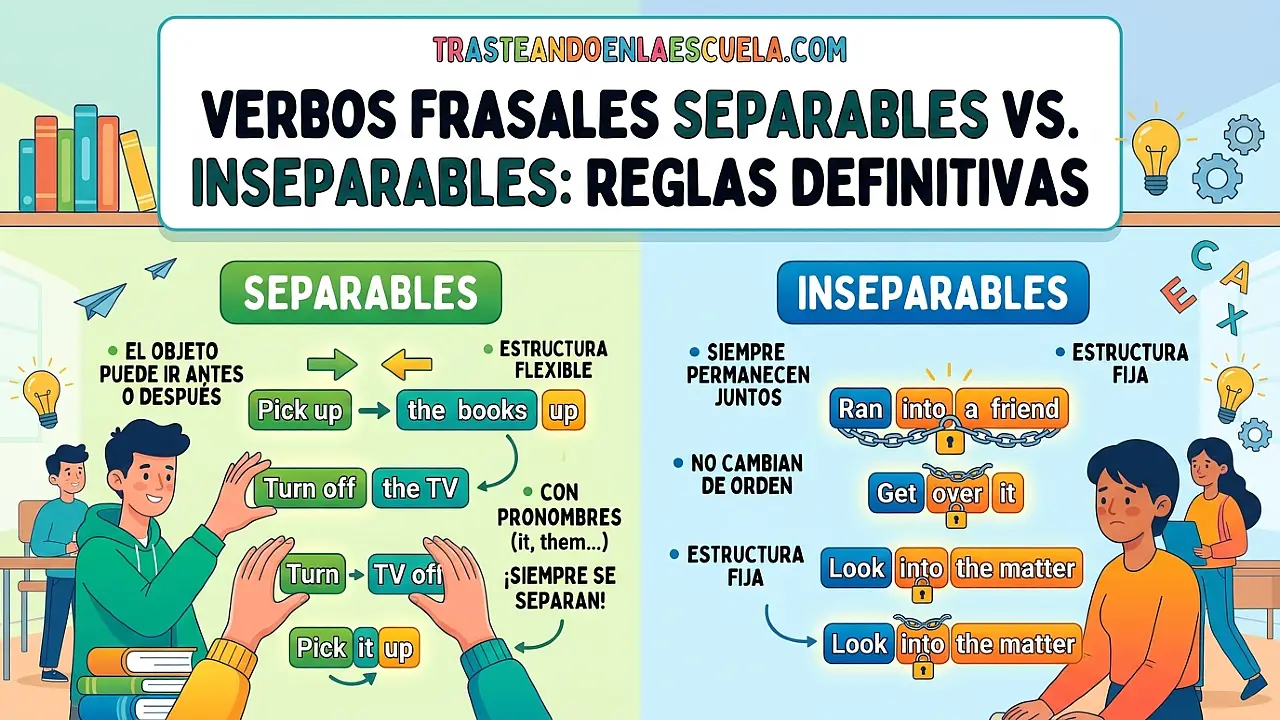
Phrasal verbs separables vs inseparables: la guía definitiva
Una de las dudas más comunes al aprender inglés es: ¿dónde coloco el objeto? ¿Puedo decir «turn the TV on» o tengo que decir «turn on the TV»? Ambas son correctas, pero no todos los phrasal verbs funcionan igual. En esta guía aprenderás a diferenciar los separables de los inseparables con reglas claras y ejemplos.
🎯 En este post aprenderás: La diferencia entre phrasal verbs separables e inseparables, cómo identificar cada tipo, reglas con pronombres, listas completas y ejercicios para practicar. Complementa tu aprendizaje con nuestras guías sobre 100 phrasal verbs esenciales y transitivos vs intransitivos.
🔍 ¿Qué significa que un phrasal verb sea separable o inseparable?
⚡ La posición del objeto lo es todo
Un phrasal verb está formado por un verbo + una partícula (preposición o adverbio). La diferencia clave es si podemos colocar el objeto entre el verbo y la partícula o no.
Separable: El objeto puede ir ENTRE el verbo y la partícula.
Inseparable: El objeto debe ir DESPUÉS de la partícula (siempre juntos).
📋 Phrasal verbs separables: reglas y ejemplos
Regla de oro de los separables
En los phrasal verbs separables, el objeto (sustantivo o pronombre) puede ir en dos posiciones. Esta flexibilidad es su característica principal.
💡 Posición con SUSTANTIVOS: Ambas opciones son correctas:
- Opción 1: Verbo + partícula + objeto (turn on the TV)
- Opción 2: Verbo + objeto + partícula (turn the TV on)
⚠️ Posición con PRONOMBRES: ¡Siempre van ENTRE el verbo y la partícula!
- Correcto: turn it on
- Incorrecto: turn on it
Lista de los phrasal verbs separables más comunes
| Phrasal Verb | Significado | Ejemplo con sustantivo | Ejemplo con pronombre |
|---|---|---|---|
| turn on | encender | turn on the TV / turn the TV on | turn it on |
| turn off | apagar | turn off the light / turn the light off | turn it off |
| pick up | recoger | pick up the kids / pick the kids up | pick them up |
| drop off | dejar | drop off the package / drop the package off | drop it off |
| put on | ponerse | put on your jacket / put your jacket on | put it on |
| take off | quitarse | take off your shoes / take your shoes off | take them off |
| give up | rendirse | give up smoking / give smoking up | give it up |
| call off | cancelar | call off the meeting / call the meeting off | call it off |
| clean up | limpiar | clean up the room / clean the room up | clean it up |
| figure out | descifrar | figure out the problem / figure the problem out | figure it out |
| fill out | rellenar | fill out the form / fill the form out | fill it out |
| hand in | entregar | hand in the homework / hand the homework in | hand it in |
| look up | buscar (info) | look up the word / look the word up | look it up |
| put away | guardar | put away the toys / put the toys away | put them away |
| throw away | tirar | throw away the trash / throw the trash away | throw it away |
📋 Phrasal verbs inseparables: reglas y ejemplos
Regla de oro de los inseparables
En los phrasal verbs inseparables, el objeto SIEMPRE va después de la partícula. No se pueden separar, y esta regla también aplica para los pronombres.
💡 Estructura fija: Verbo + partícula + objeto (siempre en este orden)
- Correcto: look after the children
- Incorrecto: look the children after
- Correcto con pronombre: look after them
- Incorrecto: look them after
Lista de los phrasal verbs inseparables más comunes
| Phrasal Verb | Significado | Ejemplo con sustantivo | Ejemplo con pronombre |
|---|---|---|---|
| look after | cuidar | look after the baby | look after her |
| look for | buscar | look for my keys | look for them |
| get over | superar | get over the illness | get over it |
| run into | encontrarse con (casualmente) | run into an old friend | run into him |
| count on | contar con | count on your help | count on it |
| go through | pasar por (experiencia) | go through a hard time | go through it |
| get along with | llevarse bien con | get along with my boss | get along with him |
| look forward to | esperar con ilusión | look forward to the trip | look forward to it |
| put up with | soportar | put up with the noise | put up with it |
| come across | encontrarse con (por casualidad) | come across an old photo | come across it |
| get through to | comunicarse con | get through to customer service | get through to them |
| run out of | quedarse sin | run out of milk | run out of it |
| take care of | cuidar, encargarse | take care of the problem | take care of it |
| break up with | terminar con (pareja) | break up with her | break up with her |
| look down on | mirar con desprecio | look down on others | look down on them |
📊 Tabla comparativa: Separables vs Inseparables
| Característica | Separables | Inseparables |
|---|---|---|
| Posición del objeto (sustantivo) | Verbo + partícula + objeto / Verbo + objeto + partícula | Verbo + partícula + objeto (única posición) |
| Posición del pronombre | Verbo + pronombre + partícula | Verbo + partícula + pronombre |
| Ejemplo (sustantivo) | turn on the TV / turn the TV on | look after the baby |
| Ejemplo (pronombre) | turn it on | look after her |
⚠️ Phrasal verbs con doble naturaleza
Algunos phrasal verbs pueden ser separables o inseparables dependiendo del significado. Aquí los más importantes:
| Phrasal Verb | Significado separable | Ejemplo | Significado inseparable | Ejemplo |
|---|---|---|---|---|
| get over | superar (enfermedad/ruptura) – inseparable | get over it | – | – |
| go over | revisar (documento) – separable | go over the report / go the report over | – | – |
| take off | quitarse (ropa) – separable | take off your hat / take your hat off | despegar (avión) – inseparable | the plane took off |
| turn down | bajar volumen/rechazar – separable | turn down the music / turn the music down | – | – |
🧪 5 Ejercicios para dominar separables e inseparables
Ejercicio 1: Separa o no separa
Indica si cada phrasal verb es separable (S) o inseparable (I):
- turn on
- look after
- put up with
- pick up
- run into
✅ Ver solución
Ejercicio 2: Reemplaza el objeto por un pronombre
Reescribe la oración usando el pronombre adecuado:
- Turn off the TV.
- Look after the children.
- Pick up your sister.
- Figure out the problem.
- Get over the flu.
✅ Ver solución
Ejercicio 3: Corrige los errores
Algunas de estas oraciones son incorrectas. Corrígelas:
- I need to look my keys for.
- Can you turn it on?
- She puts up with the noise.
- He gave up it.
- Look after them, please.
✅ Ver solución
Ejercicio 4: Completa con la forma correcta
Usa el phrasal verb en paréntesis y coloca el objeto en la posición adecuada:
- Please __________ (turn off / the lights).
- I can’t __________ (put up with / this situation).
- She __________ (pick up / her brother) at school.
- We need to __________ (figure out / it).
✅ Ver solución
Ejercicio 5: Traduce al inglés
- Cuida a tu hermano.
- Apágalo (el ordenador).
- No puedo soportar este ruido.
- Búscalo (el libro) en internet.
✅ Ver solución
📚 Serie completa: Phrasal Verbs
- 100 phrasal verbs esenciales – La lista completa.
- Separables vs inseparables: reglas – ¡Estás aquí!
- Transitivos vs intransitivos – ¿Necesitan objeto?
- Cómo aprender phrasal verbs rápido – Métodos efectivos.
- Test de phrasal verbs con respuestas – Pon a prueba tu nivel.








Publicar comentario