Phrasal Verbs con PULL: pull over, pull out, pull through
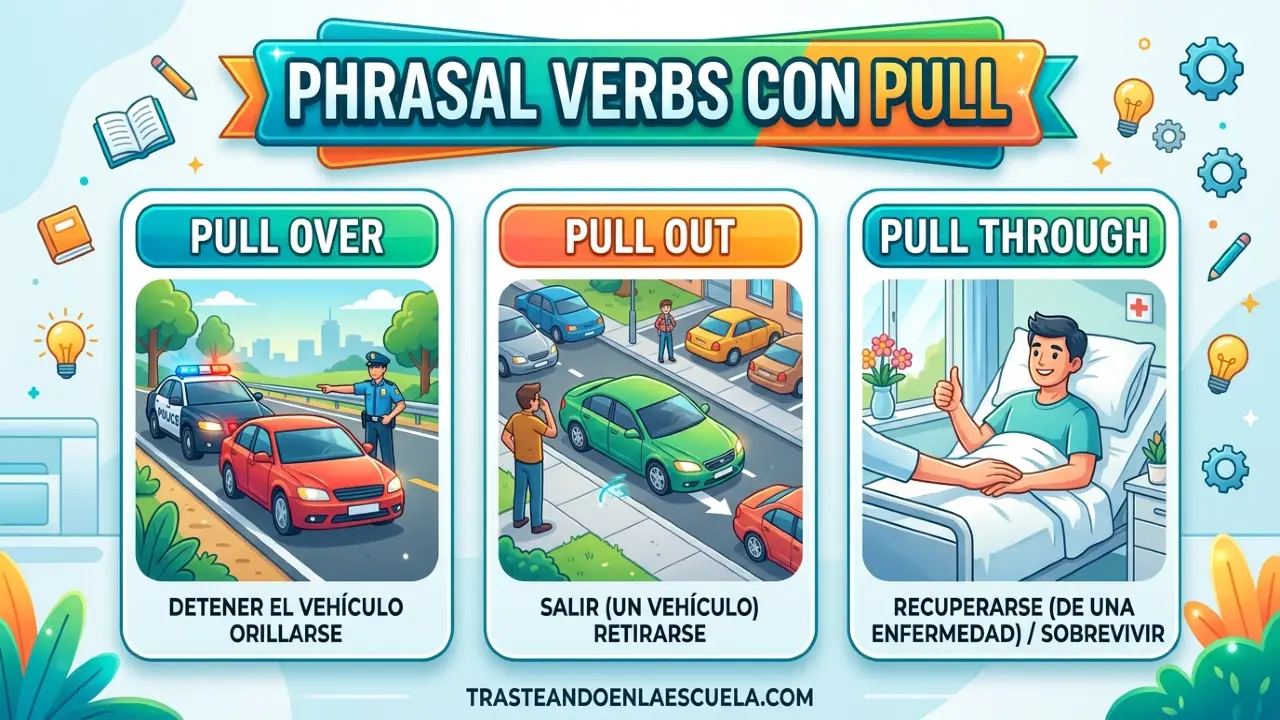
Phrasal Verbs con PULL: La guía definitiva
El verbo «pull» significa «tirar» o «jalar», pero cuando lo combinamos con partículas, su significado se transforma en acciones muy específicas y útiles. En este post, vamos a dominar tres de los phrasal verbs con «pull» más importantes: pull over, pull out y pull through. Aprenderás cuándo usar cada uno, sus estructuras y ejemplos en contextos reales.
🎯 En este post aprenderás: Los significados de pull over (detenerse al borde), pull out (salir/retirarse) y pull through (recuperarse/superar), sus estructuras gramaticales, diferencias clave, y 5 ejercicios prácticos para consolidar tu aprendizaje.
🔍 ¿Qué son los phrasal verbs con «pull»?
🚗 La fuerza de «pull» en movimiento
«Pull» implica una fuerza que acerca algo hacia uno mismo. Al añadir partículas, los significados se extienden a movimientos específicos en la carretera (pull over, pull out) y a situaciones abstractas de superación (pull through).
🚦 La analogía del viaje en coche
Imagina que estás conduciendo:
- PULL OVER: Ves una patrulla y te apartas al borde de la carretera (detenerte).
- PULL OUT: Te incorporas a la autopista desde el carril de aceleración (salir).
- PULL THROUGH: Superas una sección peligrosa de la carretera (recuperarte).
1. PULL OVER: Detenerse al borde de la carretera
🎯 Significado y estructura
Es uno de los phrasal verbs más comunes en el contexto de la conducción. Se usa cuando un vehículo se aparta para detenerse, especialmente cuando la policía te da el alto o cuando necesitas parar por una emergencia.
📝 Estructura:
pull over (intransitivo) o pull someone over (transitivo, cuando la policía detiene a alguien)
💬 Ejemplos:
- «The police officer pulled me over for speeding.» (El policía me detuvo por exceso de velocidad.)
- «I need to pull over and check the map. I think we’re lost.»
- «If you feel dizzy while driving, pull over immediately.»
- «The car behind us was flashing its lights, so we pulled over to let it pass.»
- «He was pulled over three times last year for driving without a license.»
💡 Dato clave: «Pull over» es casi sinónimo de «stop», pero con la connotación específica de apartarse hacia el arcén o borde de la carretera. Cuando la policía te detiene, siempre se dice «I was pulled over by the police», no «I was stopped».
2. PULL OUT: Salir, retirarse o extraer
🎯 Significado y estructura
Este phrasal verb tiene varios usos: el literal de salir de un lugar (como un coche saliendo de un estacionamiento), el figurado de retirarse de un proyecto o acuerdo, y el de extraer algo de algún sitio.
📝 Estructura:
pull out (intransitivo) o pull something out (transitivo)
💬 Ejemplos (salir):
- «The car pulled out of the driveway without looking.»
- «We pulled out of the parking lot and headed home.»
- «The train pulled out of the station exactly on time.»
💬 Ejemplos (retirarse):
- «The company pulled out of the deal at the last minute.»
- «Several investors pulled out after the scandal.»
- «The team pulled out of the competition due to injuries.»
💬 Ejemplos (extraer):
- «She pulled out her phone to check the time.»
- «The dentist pulled out my wisdom tooth.»
- «He pulled out a photo from his wallet.»
💡 Dato clave: En el contexto de la conducción, «pull out» es lo opuesto a «pull in» o «pull over». Si estás estacionado y te incorporas al tráfico, estás «pulling out». En los negocios, si una empresa abandona un país o mercado, se dice «the company pulled out».
3. PULL THROUGH: Recuperarse o superar una dificultad
🎯 Significado y estructura
Este phrasal verb se usa para situaciones difíciles de las que alguien o algo logra salir adelante, especialmente enfermedades graves, crisis financieras o momentos de gran dificultad.
📝 Estructura:
pull through (intransitivo) o pull someone through (transitivo, ayudar a alguien a superar algo)
💬 Ejemplos:
- «The doctors weren’t sure he would pull through after the accident.»
- «With the support of her family, she pulled through the depression.»
- «The company nearly went bankrupt, but it pulled through.»
- «The medication helped pull him through the infection.»
- «I knew you would pull through the exam. You studied so hard.»
💡 Dato clave: «Pull through» se usa casi exclusivamente para superaciones importantes. No lo uses para problemas triviales. Es muy común en contextos médicos y de crisis. Sinónimos: «survive», «overcome», «get through».
📊 Tabla comparativa: PULL OVER vs PULL OUT vs PULL THROUGH
| Phrasal Verb | Significado Principal | Uso común | Ejemplo |
|---|---|---|---|
| Pull over | Detenerse al borde | Conducción, policía | «The cop pulled me over.» |
| Pull out | Salir / Retirarse / Extraer | Vehículos, negocios, objetos | «He pulled out his keys.» |
| Pull through | Recuperarse / Superar | Enfermedades, crisis | «She pulled through the surgery.» |
⚠️ Errores comunes con PULL
| Error | Ejemplo incorrecto | Corrección | Explicación |
|---|---|---|---|
| Confundir «pull over» con «stop» sin el contexto de apartarse | I pulled over at the red light. | I stopped at the red light. | «Pull over» implica apartarse hacia el borde, no detenerse en un semáforo. |
| Usar «pull out» sin preposición para salir de un lugar | The car pulled out the garage. | The car pulled out of the garage. | Necesita «of» para indicar de dónde se sale. |
| Usar «pull through» para problemas menores | I pulled through my headache. | I got over my headache. | «Pull through» es para situaciones graves (enfermedad seria, crisis). |
🧠 5 Ejercicios prácticos
Ejercicio 1: Completa con el phrasal verb correcto (pull over, pull out, pull through)
- The police officer signaled for me to __________.
- After a long illness, she finally __________ and is back to work.
- He __________ his wallet to pay for the coffee.
- We need to __________ and check the engine. It’s making a strange noise.
- The company __________ of the project because it wasn’t profitable.
✅ Ver solución
- pull over – The police officer signaled for me to pull over.
- pulled through – After a long illness, she finally pulled through.
- pulled out – He pulled out his wallet to pay.
- pull over – We need to pull over and check the engine.
- pulled out – The company pulled out of the project.
Ejercicio 2: Traduce las siguientes frases al inglés
- El policía me detuvo porque no llevaba puesto el cinturón de seguridad.
- El coche salió del estacionamiento sin mirar.
- El médico dijo que el paciente se recuperaría.
- ¿Puedes apartarte para que pase la ambulancia?
- Sacó una foto de su bolsillo y me la enseñó.
✅ Ver solución
- The police officer pulled me over because I wasn’t wearing my seatbelt.
- The car pulled out of the parking lot without looking.
- The doctor said the patient would pull through.
- Can you pull over so the ambulance can pass?
- He pulled out a photo from his pocket and showed it to me.
Ejercicio 3: Elige la opción correcta
- The company __________ of the contract after the scandal.
a) pulled over / b) pulled out / c) pulled through - If you see a police car behind you with flashing lights, you must __________.
a) pull over / b) pull out / c) pull through - It was a difficult time, but our family __________ together.
a) pulled over / b) pulled out / c) pulled through - She __________ her diary from the drawer and started writing.
a) pulled over / b) pulled out / c) pulled through - The patient is very weak, but we are confident he will __________.
a) pull over / b) pull out / c) pull through
✅ Ver solución
- b) pulled out
- a) pull over
- c) pulled through
- b) pulled out
- c) pull through
Ejercicio 4: Completa las oraciones con la forma correcta del verbo entre paréntesis
- The car __________ (pull out) of the driveway without signaling.
- If you feel tired, you should __________ (pull over) and rest.
- Despite the financial crisis, the small business __________ (pull through).
- The driver was __________ (pull over) for using his phone while driving.
- She __________ (pull out) a notebook and began to take notes.
✅ Ver solución
- pulled out – The car pulled out of the driveway.
- pull over – You should pull over and rest.
- pulled through – The small business pulled through.
- pulled over – The driver was pulled over.
- pulled out – She pulled out a notebook.
Ejercicio 5: Crea tus propias oraciones
Completa las siguientes oraciones de manera lógica.
- (pull over) I was driving home when I saw a beautiful view, so I decided to __________.
- (pull out) As I was parking, another car suddenly __________.
- (pull through) After the surgery, the doctors said it would be hard, but I knew he would __________.
- (pull over) The police officer pulled me over because __________.
- (pull out – extraer) He pulled out his phone and __________.
✅ Ver soluciones de ejemplo
- …pull over to take a photo.
- …pulled out of a space without looking.
- …pull through because he’s a fighter.
- …I was speeding.
- …started recording the concert.
🌍 Aplicaciones en la vida real
🚗 En la conducción
- Pull over: «The highway patrol pulled me over for a broken taillight.»
- Pull out: «Always check your blind spot before pulling out.»
- Pull through: (no se usa para conducción, pero sí para situaciones extremas).
💼 En los negocios y las finanzas
- Pull out: «Investors pulled out after the market crash.»
- Pull through: «The company pulled through the recession thanks to innovation.»
🏥 En la salud y la medicina
- Pull through: «The doctors worked all night to help him pull through the surgery.»
- Pull out: «The dentist pulled out my tooth.»
📖 Glosario de términos
| Término | Definición |
|---|---|
| Pull over | Detener un vehículo apartándolo al borde de la carretera. |
| Pull out | Salir de un lugar, retirarse de un acuerdo o extraer algo. |
| Pull through | Recuperarse de una enfermedad grave o superar una crisis importante. |
📚 Serie completa: Phrasal Verbs con CARRY, BRING, PULL
- Carry on, carry out, carry over – Primer post del cluster.
- Bring up, bring back, bring in – Segundo post del cluster.
- Pull over, pull out, pull through – ¡Estás aquí!
- Pull off (lograr algo difícil) – Próximo post del cluster.
- Ejercicios phrasal verbs variados – Practica todos los phrasal verbs del cluster.
🏆 Reto final: Imagina una historia corta (en inglés) que incluya los tres phrasal verbs. Por ejemplo: «I was driving home when I saw a police car behind me. I pulled over, but the officer just wanted to warn me about a hazard ahead. I pulled out carefully and continued. A few miles later, I had a flat tire. I pulled over again, but luckily a tow truck helped me pull through that difficult situation.» ¡Comparte tu historia con un amigo para practicar!







Publicar comentario