Phrasal Verbs con BRING: bring up, bring back, bring in
Phrasal Verbs con BRING: La guía definitiva
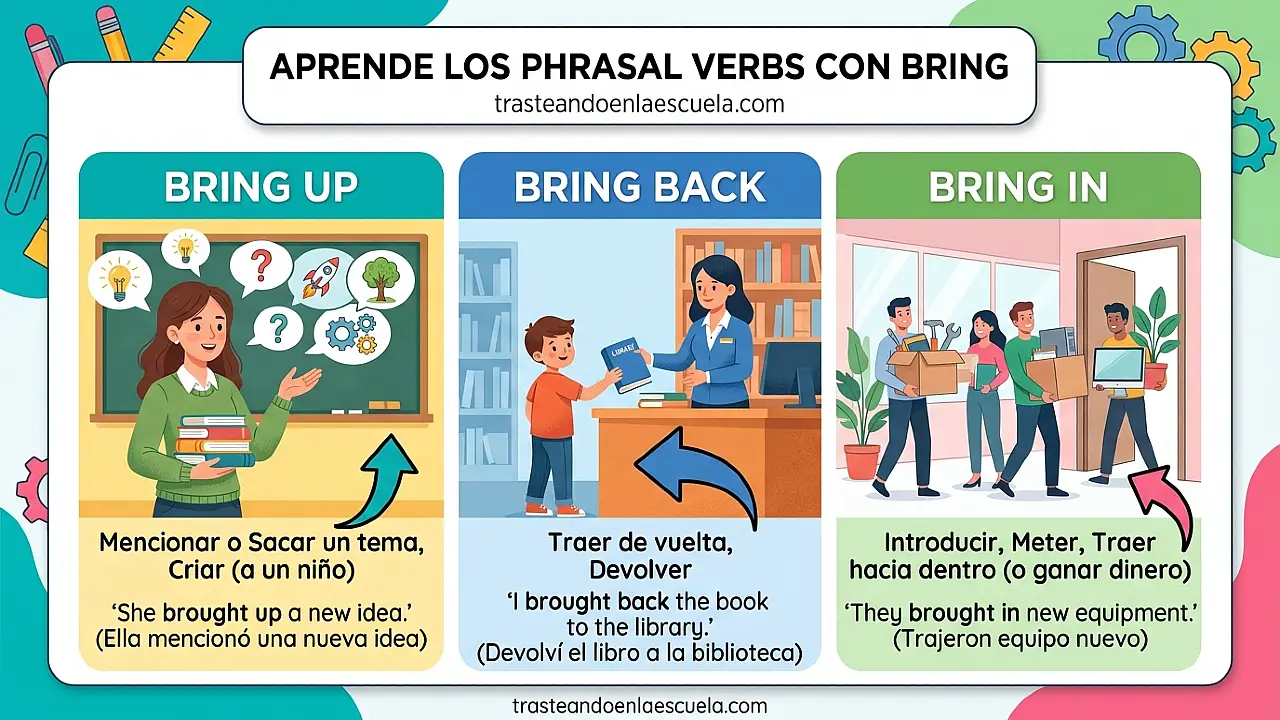
El verbo «bring» significa «traer», pero cuando lo combinamos con diferentes partículas, obtenemos significados muy variados. En este post, vamos a dominar tres de los phrasal verbs con «bring» más útiles en inglés: bring up, bring back y bring in. Aprenderás cuándo usar cada uno, sus estructuras y ejemplos en contextos reales.
🎯 En este post aprenderás: Los significados de bring up (mencionar/criar), bring back (devolver/recordar) y bring in (introducir/ganar), sus estructuras gramaticales, diferencias clave, y 5 ejercicios prácticos para consolidar tu aprendizaje.
🔍 ¿Qué son los phrasal verbs con «bring»?
🔙 La versatilidad de «bring»
«Bring» implica movimiento hacia el hablante o un punto de referencia. Al añadir partículas, el significado se extiende a acciones abstractas como mencionar un tema, criar a un niño, traer recuerdos, introducir cambios o generar ingresos.
🏡 La analogía del hogar
Imagina tu casa:
- BRING UP: Un padre «trae arriba» (cria) a un niño; o en una conversación, «traes a la mesa» un tema (mencionas).
- BRING BACK: Traes algo de vuelta a casa (devolver) o un recuerdo «vuelve» a tu mente.
- BRING IN: Traes cosas nuevas al hogar (introducir) o traes dinero (ganar).
1. BRING UP: Mencionar un tema o criar a un niño
🎯 Significado y estructura
Es uno de los phrasal verbs más polivalentes. En un contexto conversacional, «bring up» significa introducir un tema de discusión. En un contexto familiar, significa cuidar y educar a un niño hasta la edad adulta.
📝 Estructura:
bring up + objeto (es separable, podemos decir «bring the topic up» o «bring up the topic»)
💬 Ejemplos (mencionar):
- «I didn’t want to bring up politics at dinner.»
- «She brought up a very interesting point during the meeting.»
- «Please don’t bring up that subject again. It’s uncomfortable.»
- «Why did you bring up his ex-girlfriend? You know it bothers him.»
💬 Ejemplos (criar):
- «She was brought up in a small town in Texas.» (Fue criada)
- «They brought up their children to be respectful and honest.»
- «My grandparents brought me up after my parents passed away.»
- «It’s not easy to bring up a child alone.»
💡 Dato clave: En el contexto de «criar», «bring up» es equivalente a «raise». «Bring up» es más informal y se usa mucho para la educación moral y los valores. El participio «brought up» es muy común para describir la infancia de alguien: «I was brought up in a musical family.»
2. BRING BACK: Devolver algo o traer recuerdos
🎯 Significado y estructura
Este phrasal verb tiene dos usos principales: el literal (devolver un objeto a su lugar) y el figurado (hacer que un recuerdo vuelva a la mente).
📝 Estructura:
bring something back (to someone/somewhere)
💬 Ejemplos (devolver):
- «Can you bring back the book you borrowed?»
- «I need to bring these shoes back to the store. They’re too small.»
- «Please bring back my keys when you’re done.»
- «The library allows you to bring back books up to three weeks late.»
💬 Ejemplos (recordar):
- «This song brings back so many memories of our childhood.»
- «Seeing her again brought back all those old feelings.»
- «The smell of cookies brought back memories of my grandmother’s kitchen.»
- «That photograph brought back the best moments of our trip.»
💡 Dato clave: Para usar «bring back» en el sentido de recuerdo, es muy común la estructura «bring back + memories» o «bring back + feelings». También se usa con «it» como sujeto impersonal: «It brings back so much.»
3. BRING IN: Introducir, contratar o generar ingresos
🎯 Significado y estructura
Este phrasal verb es muy versátil. Se usa para introducir algo nuevo (una ley, un sistema), para traer a alguien experto a un equipo, o para indicar cuánto dinero se genera.
📝 Estructura:
bring in + objeto
💬 Ejemplos (introducir):
- «The company plans to bring in a new policy on remote work.»
- «They brought in a law to ban plastic bags.»
- «We need to bring in some changes to improve efficiency.»
💬 Ejemplos (contratar expertos):
- «The police brought in a specialist to solve the case.»
- «We should bring in an external consultant to help us.»
- «The school brought in a famous speaker for the graduation ceremony.»
💬 Ejemplos (ganar dinero):
- «His business brings in over a million dollars a year.» (Genera)
- «My side hustle brings in an extra $500 a month.»
- «How much does this project bring in for the company?»
- «The new product is bringing in record profits.»
💡 Dato clave: «Bring in» es el phrasal verb perfecto para hablar de negocios y finanzas. Puedes decir «the business brings in X dollars» para hablar de ingresos. También es común en el ámbito laboral para hablar de contrataciones temporales de expertos.
📊 Tabla comparativa: BRING UP vs BRING BACK vs BRING IN
| Phrasal Verb | Significado Principal | Uso común | Ejemplo |
|---|---|---|---|
| Bring up | Mencionar / Criar | Conversaciones, temas tabú, infancia | «Don’t bring up that topic.» |
| Bring back | Devolver / Recordar | Objetos prestados, nostalgia | «This song brings back memories.» |
| Bring in | Introducir / Contratar / Ganar | Políticas, expertos, ingresos | «The company brings in $1M.» |
⚠️ Errores comunes con BRING
| Error | Ejemplo incorrecto | Corrección | Explicación |
|---|---|---|---|
| Confundir «bring up» con «raise» en contexto de criar | I was raised in Madrid. (correcto) / I was brought up in Madrid. (también correcto) | Ambos son válidos | «Bring up» es más informal para «criar». «Raise» es más común en EE.UU. para este contexto. |
| Olvidar el objeto en «bring in» | The new law will bring in. (incompleto) | The new law will bring in changes. | «Bring in» es transitivo, necesita un objeto. |
| Usar «bring back» en lugar de «take back» | I need to bring this to the library. (depende) | Si el hablante está en la biblioteca: I need to bring this to the library. / Si está en casa: I need to take this back to the library. | «Bring» implica movimiento hacia el lugar del hablante; «take» implica alejamiento. |
🧠 5 Ejercicios prácticos
Ejercicio 1: Completa con el phrasal verb correcto (bring up, bring back, bring in)
- I was ___________ in a very strict household.
- This old photograph ___________ so many happy memories.
- The government plans to ___________ a new law to reduce pollution.
- Please don’t ___________ that embarrassing story at the party.
- His online business ___________ over $10,000 a month.
✅ Ver solución
- brought up – I was brought up in a very strict household.
- brings back – This old photograph brings back so many happy memories.
- bring in – The government plans to bring in a new law.
- bring up – Please don’t bring up that embarrassing story.
- brings in – His online business brings in over $10,000 a month.
Ejercicio 2: Traduce las siguientes frases al inglés
- No menciones el tema del dinero en la cena.
- Esta canción me trae recuerdos de mi juventud.
- La compañía contrató a un nuevo director para el proyecto.
- Ella fue criada por sus abuelos.
- ¿Puedes devolverme mi cargador cuando termines?
✅ Ver solución
- Don’t bring up the topic of money at dinner.
- This song brings back memories of my youth.
- The company brought in a new director for the project.
- She was brought up by her grandparents.
- Can you bring back my charger when you’re done?
Ejercicio 3: Elige la opción correcta
- I need to ___________ the library book before it’s overdue.
a) bring up / b) bring back / c) bring in - She ___________ three children on her own after her husband died.
a) brought up / b) brought back / c) brought in - The new CEO plans to ___________ a lot of changes.
a) bring up / b) bring back / c) bring in - Seeing the old house ___________ a flood of emotions.
a) brought up / b) brought back / c) brought in - During the meeting, he ___________ the issue of budget cuts.
a) brought up / b) brought back / c) brought in
✅ Ver solución
- b) bring back
- a) brought up
- c) bring in
- b) brought back
- a) brought up
Ejercicio 4: Completa las oraciones con la forma correcta del verbo entre paréntesis
- If you __________ (bring up) that topic, she will get angry.
- The smell of fresh bread always __________ (bring back) memories of my childhood.
- A new expert was __________ (bring in) to help with the investigation.
- They __________ (bring up) their children to be very independent.
- This new app __________ (bring in) millions in revenue last year.
✅ Ver solución
- bring up – If you bring up that topic, she will get angry.
- brings back – The smell of fresh bread always brings back memories.
- brought in – A new expert was brought in to help.
- brought up – They brought up their children to be very independent.
- brought in – This new app brought in millions in revenue.
Ejercicio 5: Crea tus propias oraciones
Completa las siguientes oraciones de manera lógica.
- (bring up – mencionar) I didn’t want to bring up the subject of ____________________.
- (bring back – recuerdo) That movie brings back ____________________.
- (bring in – ganar dinero) My part-time job brings in ____________________.
- (bring up – criar) I was brought up to believe that ____________________.
- (bring in – introducir) The school brought in a new rule about ____________________.
✅ Ver soluciones de ejemplo
- …politics at dinner.
- …memories of my first love.
- …an extra $300 a month.
- …honesty is the best policy.
- …using cell phones in class.
🌍 Aplicaciones en la vida real
🏠 En la familia y las relaciones
- Bring up (criar): «My parents brought me up with strong values.»
- Bring up (mencionar): «It’s awkward to bring up salaries with friends.»
- Bring back: «That song brings back memories of our first date.»
💼 En el trabajo y los negocios
- Bring up: «I’ll bring up the budget issue in the meeting.»
- Bring in: «We need to bring in a consultant to fix this.» / «Our new product brings in 40% of revenue.»
- Bring back: «Please bring back the signed contract tomorrow.»
📚 En contextos académicos
- Bring up: «The professor brought up an interesting theory in class.»
- Bring back: «I need to bring back this book to the library.»
- Bring in: «The school brought in a guest speaker for the event.»
📖 Glosario de términos
| Término | Definición |
|---|---|
| Bring up | Mencionar un tema en conversación o criar y educar a un niño. |
| Bring back | Devolver algo a su lugar o hacer que un recuerdo vuelva a la mente. |
| Bring in | Introducir algo nuevo, contratar a alguien o generar ingresos. |
📚 Serie completa: Phrasal Verbs con CARRY, BRING, PULL
- Carry on, carry out, carry over – Anterior post del cluster.
- Bring up, bring back, bring in – ¡Estás aquí!
- Pull over, pull out, pull through – Próximo post del cluster.
- Pull off (lograr algo difícil) – Un phrasal verb muy expresivo.
- Ejercicios phrasal verbs variados – Practica todos los phrasal verbs del cluster.
🏆 Reto final: Escribe un pequeño párrafo sobre tu infancia usando «bring up» (criar) y un recuerdo que «brings back» nostalgia. Luego, describe un cambio reciente en tu trabajo o ciudad usando «bring in». Comparte tus frases con alguien que esté aprendiendo inglés para practicar juntos.










Publicar comentario