Get along, get over, get through: relaciones y superación
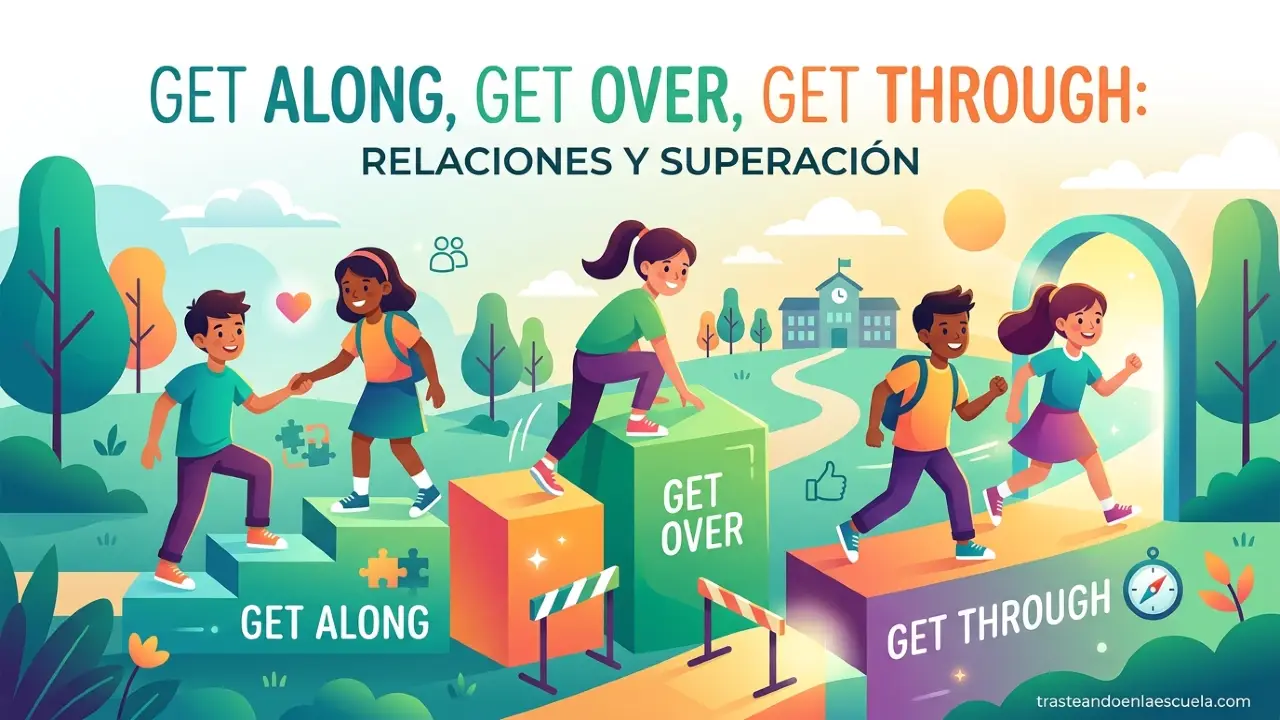
Get along, over & through: El lado emocional de GET
Después de dominar los phrasal verbs más físicos (up, out, on, off), es hora de explorar los que conectan con nuestras emociones y relaciones humanas. Estos tres verbos son esenciales para hablar de cómo nos llevamos con los demás, cómo superamos adversidades y cómo nos comunicamos en los momentos difíciles.
🎯 En este post aprenderás: Los significados de get along, get over y get through, sus usos más comunes, diferencias clave y ejercicios para usarlos con confianza.
🤝 Get along: La química interpersonal
👥 Get along = Llevarse bien / Congeniar
Este phrasal verb describe la relación armoniosa entre dos o más personas. Es uno de los verbos más usados en el ámbito social y laboral.
📌 Estructura: Get along with + alguien
📌 Uso común: Hablar de compañeros de trabajo, familia, amigos.
Ejemplo: «I get along very well with my mother-in-law.» (Me llevo muy bien con mi suegra).
Ejemplo 2: «Do you get along with your new boss?» (¿Te llevas bien con tu nuevo jefe?).
💬 Ejemplos en diferentes contextos:
- «We don’t get along. We argue all the time.» → No nos llevamos bien. Discutimos todo el tiempo.
- «It’s important that team members get along.» → Es importante que los miembros del equipo se lleven bien.
- «How do your pets get along with each other?» → ¿Cómo se llevan tus mascotas entre sí?
- «Despite their differences, they get along surprisingly well.» → A pesar de sus diferencias, se llevan sorprendentemente bien.
🧠 Truco: Imagina que dos personas caminan juntas por el mismo camino (along). Si «caminan juntas» en armonía, significa que se llevan bien. «To get along» es sinónimo de «to get on» (UK). Puedes repasar la diferencia en nuestro post sobre Get on.
🌈 Get over: Superar obstáculos y emociones
⛰️ Get over = Superar / Recuperarse
Usamos «get over» para hablar de superar enfermedades, problemas emocionales (como una ruptura) o cualquier tipo de obstáculo. Implica un proceso de recuperación.
📌 Enfermedad: «I’m still getting over the flu.» (Todavía me estoy recuperando de la gripe).
📌 Emociones: «It took her years to get over the breakup.» (Le llevó años superar la ruptura).
📌 Sorpresa: «I can’t get over how much you’ve grown!» (¡No puedo superar lo mucho que has crecido!).
💬 Ejemplos para cada situación:
- Salud: «He’s finally getting over his cold.» → Finalmente se está recuperando de su resfriado.
- Emocional: «You need time to get over the loss of a loved one.» → Necesitas tiempo para superar la pérdida de un ser querido.
- Sorpresa/Incredulidad: «I can’t get over the fact that we won the lottery!» → ¡No puedo creer que hayamos ganado la lotería!
- Problemas prácticos: «We’ll have to get over this technical issue to continue.» → Tendremos que superar este problema técnico para continuar.
🧠 Truco: Visualiza un obstáculo (una roca, una pared). Cuando lo superas, estás literalmente «pasando por encima» (over) de él. Ya no te bloquea el camino.
📞 Get through: Conectar en los momentos difíciles
🛣️ Get through = Atravesar / Comunicarse / Terminar
Este verbo tiene tres usos principales: sobrevivir a un período difícil, lograr comunicarse (especialmente por teléfono) y terminar una tarea.
📌 Atravesar dificultades: «We got through the crisis together.» (Atravesamos la crisis juntos).
📌 Contactar (teléfono): «I tried calling, but I couldn’t get through.» (Intenté llamar, pero no pude comunicarme).
📌 Terminar algo: «I need to get through this report by 5 p.m.» (Necesito terminar este informe para las 5 p.m.).
📌 Hacerse entender: «I just can’t get through to him.» (Simplemente no consigo hacerme entender con él).
💬 Ejemplos detallados:
- Dificultad: «I don’t know how I’ll get through this week without coffee.» → No sé cómo voy a sobrevivir a esta semana sin café.
- Teléfono: «The lines were busy and I couldn’t get through to the hospital.» → Las líneas estaban ocupadas y no pude comunicarme con el hospital.
- Tarea: «I’ve got a huge pile of work to get through.» → Tengo una montaña de trabajo que terminar.
- Comunicación: «She’s so stubborn. It’s hard to get through to her.» → Es muy testaruda. Es difícil hacerle entender algo.
🧠 Truco: «Through» implica atravesar un túnel. Puede ser un túnel de dificultades, un túnel telefónico (hasta que te contestan) o un túnel de trabajo que tienes que terminar para ver la luz al final.
⚔️ Comparativa: Get over vs Get through
A menudo se confunden porque ambos implican «superar» algo. Sin embargo, la diferencia es sutil pero importante.
❤️ GET OVER
- Enfoque: En la recuperación emocional o física después de un evento.
- Sensación: Es algo que te afecta internamente (enfermedad, sentimientos).
- Ejemplo: «He got over his ex-girlfriend.» (Superó a su ex).
- Uso típico: Breakups, illnesses, shocks.
📞 GET THROUGH
- Enfoque: En sobrevivir o gestionar una situación o período difícil.
- Sensación: Es algo externo que tienes que «pasar» (un examen, una crisis, un día duro).
- Ejemplo: «I don’t know how I’ll get through this week.» (No sé cómo voy a pasar esta semana).
- Uso típico: Difficult times, tasks, phone calls.
📌 Ejemplo para ver la diferencia: «She got over her illness, but she’s still struggling to get through the long days of recovery.» (Ella superó su enfermedad, pero todavía lucha por sobrellevar los largos días de recuperación).
📊 Tabla resumen
| Phrasal Verb | Significado Principal | Ejemplo | Traducción |
|---|---|---|---|
| Get along (with) | Llevarse bien | I get along with my colleagues. | Me llevo bien con mis colegas. |
| Get over | Superar (enfermedad/emoción) | She got over her fear of flying. | Superó su miedo a volar. |
| Get through (to) | Atravesar / Comunicarse | I finally got through to her. | Finalmente logré contactarla/hacerme entender. |
🧠 Ejercicios prácticos
Ejercicio 1: Elige el phrasal verb correcto
Completa con get along, get over, o get through.
- My dog and my cat don’t _____ _____ with each other.
- It took him months to _____ _____ the accident.
- I have so much paperwork to _____ _____ this weekend.
- Do you _____ _____ with your in-laws?
- I tried to call you, but I couldn’t _____ _____ . The line was busy.
✅ Ver soluciones
- get along (Llevarse bien)
- get over (Superar un trauma)
- get through (Terminar el papeleo)
- get along (Relación con suegros)
- get through (Comunicarse por teléfono)
Ejercicio 2: Completa con la preposición correcta (along, over, through)
- How do you get _____ with your new roommate?
- She can’t get _____ the fact that she failed the exam.
- We need to get _____ this project before the deadline.
- I’ve never been able to get _____ to my father about my feelings.
- It’s hard to get _____ a serious illness.
✅ Ver soluciones
- along (Relación)
- over (Superar una decepción)
- through (Terminar un proyecto)
- through (Comunicación profunda)
- over (Recuperarse de una enfermedad)
Ejercicio 3: Traduce al inglés
- ¿Te llevas bien con tu hermano? li>Todavía no he superado la muerte de mi abuelo.
- No pude comunicarme con la oficina ayer.
- Es difícil superar un resfriado en invierno.
- ¿Cómo vas a sobrellevar (pasar) este mes tan ocupado?
✅ Ver soluciones
- Do you get along with your brother?
- I haven’t gotten over my grandfather’s death yet.
- I couldn’t get through to the office yesterday.
- It’s hard to get over a cold in winter.
- How are you going to get through this busy month?
Ejercicio 4: Diálogo contextual
Rellena los huecos.
Ana: «Hey, how are you? I heard you were sick.»
Ben: «I’m much better now, thanks. I’m finally _____ _____ (1) the flu.»
Ana: «Glad to hear it. Listen, I tried to call you last night but I couldn’t _____ _____ (2).»
Ben: «Yeah, sorry. My phone was off. I have so much work to _____ _____ (3) this week.»
Ana: «I understand. By the way, how are you _____ _____ (4) with the new intern?»
Ben: «Surprisingly well! We really _____ _____ (5). He’s very helpful.»
✅ Ver soluciones
- getting over (Recuperándome de la gripe)
- get through (Comunicarme por teléfono)
- get through (Terminar el trabajo)
- getting along (Llevándose con el becario)
- get along (Se llevan bien)
Ejercicio 5: Verdadero o Falso
- «Get over» se puede usar para superar una ruptura amorosa.
- «Get along» significa lo mismo que «get on» en inglés británico.
- Para decir que terminas un libro, puedes usar «get through the book».
- «Get through» solo se usa para hablar por teléfono.
- Si alguien no te entiende, puedes decir «I can’t get along to you».
✅ Ver soluciones
- Verdadero. «Get over a breakup» es muy común.
- Verdadero. «Get on» es la versión británica de «get along».
- Verdadero. «I got through the book in one day.»
- Falso. También significa sobrevivir a algo o terminar una tarea.
- Falso. La forma correcta es «I can’t get through to you».
📚 Continúa con el cluster de GET
- Get up, get out, get on, get off – Los básicos
- Get along, get over, get through (Estás aquí)
- Get by, get away, get back – Supervivencia y regreso
- Get in vs get into: diferencias – Matices importantes
- 50 phrasal verbs con GET (lista PDF) – El pack completo









Publicar comentario