Good at, bad at, interested in: cómo usarlos correctamente
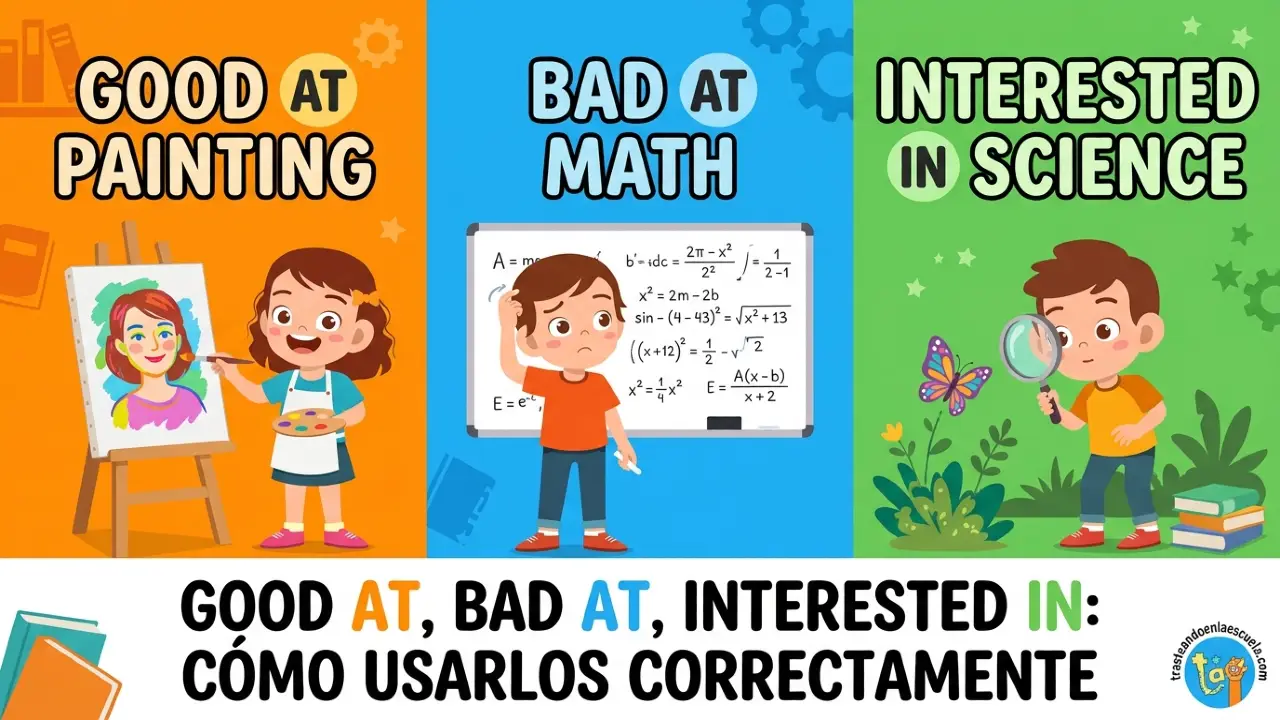
Good at, bad at, interested in: Domina las expresiones más útiles del inglés
¿Eres good at los idiomas? ¿O quizás eres bad at los deportes? ¿Y qué cosas te interested in? Estas tres expresiones están entre las más usadas del inglés… y también entre las que más errores causan. La razón es simple: en español decimos «bueno EN», pero en inglés es «good AT». Un pequeño cambio que puede marcar una gran diferencia.
🎯 En este post aprenderás: El significado exacto de cada expresión, cómo usarlas correctamente, la estructura gramatical que las sigue, ejemplos en contextos reales, y ejercicios para practicar hasta dominarlas.
🔍 Las tres expresiones clave
📊 Comparativa rápida
GOOD AT
Bueno en / Habilidad
BAD AT
Malo en / Falta de habilidad
INTERESTED IN
Interesado en / Interés
SUJETO + VERBO TO BE + ADJETIVO + PREPOSICIÓN
I am good at music
She is bad at maths
They are interested in art
📚 Good at: Habilidad positiva
✅ Significado y uso
Good at significa «ser bueno en algo», tener habilidad o destreza para una actividad específica. Se usa para hablar de talentos, capacidades aprendidas o habilidades naturales.
Estructura gramatical
- Good at + sustantivo: I’m good at music. (Soy bueno en música)
- Good at + gerundio (-ing): I’m good at playing the guitar. (Soy bueno tocando la guitarra)
| Categoría | Ejemplos con sustantivo | Ejemplos con gerundio |
|---|---|---|
| Deportes | good at football (fútbol) | good at swimming (nadar) |
| Idiomas | good at languages (idiomas) | good at speaking English (hablar inglés) |
| Arte | good at drawing (dibujo) | good at painting (pintar) |
| Académico | good at maths (mates) | good at solving problems (resolver problemas) |
| Música | good at piano (piano) | good at singing (cantar) |
| Tecnología | good at computers (ordenadores) | good at coding (programar) |
📝 Ejemplos en contexto:
- «My sister is really good at maths. She always helps me with my homework.» (Mi hermana es muy buena en matemáticas. Siempre me ayuda con los deberes)
- «I’m not very good at remembering names.» (No soy muy bueno recordando nombres)
- «He’s good at making people laugh.» (Es bueno haciendo reír a la gente)
- «She’s good at languages. She speaks five!» (Es buena en idiomas. ¡Habla cinco!)
- «We need someone who’s good at public speaking.» (Necesitamos a alguien que sea bueno hablando en público)
📚 Bad at: Falta de habilidad
❌ Significado y uso
Bad at es el opuesto directo de good at. Significa «ser malo en algo», no tener habilidad o destreza para una actividad. Es importante recordar que en inglés no usamos «bad in» en estos casos.
Estructura gramatical
- Bad at + sustantivo: I’m bad at sports. (Soy malo en deportes)
- Bad at + gerundio (-ing): I’m bad at cooking. (Soy malo cocinando)
| Categoría | Ejemplos con sustantivo | Ejemplos con gerundio |
|---|---|---|
| Deportes | bad at tennis (tenis) | bad at running (correr) |
| Manualidades | bad at DIY (bricolaje) | bad at fixing things (arreglar cosas) |
| Social | bad at small talk (conversación trivial) | bad at remembering faces (recordar caras) |
| Cocina | bad at baking (repostería) | bad at following recipes (seguir recetas) |
| Organización | bad at planning (planificación) | bad at managing time (gestionar el tiempo) |
📝 Ejemplos en contexto:
- «I’m terrible – I’m really bad at dancing.» (Soy terrible – soy muy malo bailando)
- «He’s bad at keeping secrets. He always tells everyone.» (Es malo guardando secretos. Siempre se los cuenta a todos)
- «Don’t ask me to cook. I’m bad at it!» (No me pidas que cocine. ¡Soy malo en eso!)
- «She’s bad at directions. She gets lost easily.» (Es mala con las direcciones. Se pierde fácilmente)
- «I’m bad at mornings. I need two coffees to wake up.» (Soy malo por las mañanas. Necesito dos cafés para despertarme)
💡 Intensificadores: Puedes usar palabras como really, very, terrible, absolutely para dar más énfasis:
- I’m really bad at cooking. (Soy realmente malo cocinando)
- She’s absolutely terrible at maths. (Es absolutamente terrible en matemáticas)
- He’s not very good at tennis. (No es muy bueno en tenis – forma más suave de decir que es malo)
📚 Interested in: Interés y aficiones
🤔 Significado y uso
Interested in significa «estar interesado en algo». A diferencia de good/bad at, que hablan de habilidad, interested in habla de interés, gusto o atracción por algo. Puedes ser malo en algo pero estar muy interesado en ello.
Estructura gramatical
- Interested in + sustantivo: I’m interested in history. (Estoy interesado en historia)
- Interested in + gerundio (-ing): I’m interested in learning Japanese. (Estoy interesado en aprender japonés)
⚠️ Diferencia clave
Good at = habilidad (sé hacerlo bien)
Interested in = interés (me gusta, quiero aprender)
Puedes decir: «I’m interested in painting, but I’m not very good at it.» (Estoy interesado en pintar, pero no soy muy bueno)
| Categoría | Ejemplos con sustantivo | Ejemplos con gerundio |
|---|---|---|
| Cultura | interested in art (arte) | interested in visiting museums (visitar museos) |
| Ciencia | interested in astronomy (astronomía) | interested in learning about space (aprender sobre el espacio) |
| Viajes | interested in other cultures (otras culturas) | interested in travelling (viajar) |
| Desarrollo personal | interested in self-improvement (superación) | interested in meditation (meditar) |
| Tecnología | interested in AI (inteligencia artificial) | interested in coding (programar) |
📝 Ejemplos en contexto:
- «I’m very interested in photography. I take my camera everywhere.» (Estoy muy interesado en fotografía. Llevo mi cámara a todas partes)
- «She’s interested in starting her own business.» (Está interesada en empezar su propio negocio)
- «Are you interested in politics?» (¿Te interesa la política?)
- «He’s not interested in sports at all.» (No le interesan los deportes en absoluto)
- «We’re interested in buying a house in this area.» (Estamos interesados en comprar una casa en esta zona)
⚡ Comparativa: Habilidad vs Interés
🎯 Tabla comparativa completa
| Expresión | Significado | Preposición | Ejemplo correcto | Error típico |
|---|---|---|---|---|
| Good at | Habilidad positiva | AT | I’m good at tennis | I’m good in tennis ❌ |
| Bad at | Falta de habilidad | AT | I’m bad at maths | I’m bad in maths ❌ |
| Interested in | Interés | IN | I’m interested in art | I’m interested on/about art ❌ |
📊 Escala de habilidad vs interés
Nota: Puedes tener alto interés (interested in) pero baja habilidad (bad at), y viceversa.
🧪 Ejercicios prácticos
Ejercicio 1: Completa con at o in
- She’s very good ______ French.
- I’m interested ______ learning Chinese.
- He’s bad ______ remembering names.
- Are you interested ______ modern art?
- My brother is good ______ fixing cars.
- We’re bad ______ directions. We always get lost.
- The kids are interested ______ dinosaurs.
- I’m not very good ______ public speaking.
- She’s interested ______ becoming a doctor.
- He’s bad ______ saving money.
✅ Ver soluciones
- good at French
- interested in learning
- bad at remembering
- interested in modern art
- good at fixing
- bad at directions
- interested in dinosaurs
- good at public speaking
- interested in becoming
- bad at saving
Ejercicio 2: Elige la opción correcta
- I’m not very good at / in / on sports.
- She’s interested in / at / about psychology.
- He’s really bad at / in / for cooking.
- Are you interested in / on / at joining the club?
- My sister is good at / in / with languages.
- I’m bad at / in / about remembering dates.
- We’re interested in / at / for buying a new car.
- He’s not very good at / in / on maths.
- She’s interested in / at / about starting a business.
- I’m terrible – I’m really bad at / in / for dancing.
✅ Ver soluciones
- good at
- interested in
- bad at
- interested in
- good at
- bad at
- interested in
- good at
- interested in
- bad at
Ejercicio 3: Traduce al inglés
- Soy muy bueno en matemáticas. li>¿Estás interesado en la historia?
- Mi hermana es mala cocinando.
- No soy muy bueno recordando nombres.
- Estamos interesados en viajar a Japón.
- Él es malo en los deportes.
- Ella es buena en idiomas. Habla cuatro.
- ¿Te interesa la política?
- Soy malo ahorrando dinero.
- Los niños están interesados en los dinosaurios.
✅ Ver traducciones
- I’m very good at maths.
- Are you interested in history?
- My sister is bad at cooking.
- I’m not very good at remembering names.
- We’re interested in travelling to Japan.
- He’s bad at sports.
- She’s good at languages. She speaks four.
- Are you interested in politics?
- I’m bad at saving money.
- The children are interested in dinosaurs.
Ejercicio 4: Completa las frases con la forma correcta (-ing o sustantivo)
- I’m good at ______ (swim).
- She’s interested in ______ (learn) Spanish.
- He’s bad at ______ (remember) birthdays.
- We’re interested in ______ (travel).
- They’re good at ______ (play) chess.
- I’m bad at ______ (save) money.
- Are you interested in ______ (join) the team?
- She’s good at ______ (draw).
- He’s bad at ______ (tell) jokes.
- We’re interested in ______ (buy) a house.
✅ Ver soluciones
- good at swimming
- interested in learning
- bad at remembering
- interested in travelling
- good at playing
- bad at saving
- interested in joining
- good at drawing
- bad at telling
- interested in buying
Ejercicio 5: Escribe frases verdaderas sobre ti
- Something I’m good at: _________________
- Something I’m bad at: _________________
- Something I’m interested in: _________________
- Something a family member is good at: _________________
- Something a friend is interested in: _________________
- Something I’m not very good at: _________________
- Something I’m really interested in: _________________
- Something I’m terrible at: _________________
Este ejercicio es personal – ¡no hay respuestas correctas o incorrectas!
🎭 Conversaciones cotidianas
🗣️ En una fiesta:
Anna: «So, tell me about yourself. What are you interested in?»
Mark: «Well, I’m really interested in photography. I love taking photos of nature. What about you?»
Anna: «I’m interested in music. I play the guitar.»
Mark: «Are you good at it?»
Anna: «I’m OK, but I’m not very good at singing. I’m terrible at it actually!»
Mark: «I’m sure you’re not that bad at it!»
🗣️ En la escuela:
Teacher: «Who’s good at maths in this class?»
Student: «Sarah is really good at it. She always helps us.»
Teacher: «And who’s interested in joining the maths club?»
Student: «I am! I know I’m not very good at maths, but I’m really interested in learning more.»
Teacher: «That’s great! You don’t have to be good at something to be interested in it.»
📝 Errores comunes y cómo evitarlos
| Error típico | Causa | Solución | Frase correcta |
|---|---|---|---|
| «I’m good in English» | Traducción literal de «bueno EN» | Recuerda: habilidad = AT | I’m good at English |
| «I’m interested on art» | Confusión con «on» como «en» | Interés siempre = IN | I’m interested in art |
| «I’m bad in cooking» | Mismo error que con good | Habilidad negativa = AT | I’m bad at cooking |
| «I’m good at to play tennis» | Usar infinitivo en lugar de gerundio | Después de preposición va -ing | I’m good at playing tennis |
| «I’m interest in music» | Olvidar el adjetivo «interested» | Interested es adjetivo, necesita verb to be | I’m interested in music |
🎯 Truco definitivo para recordarlo:
- AT = APUNTAR: Cuando eres bueno en algo, «apuntas» bien al objetivo (good AT).
- IN = DENTRO: Cuando algo te interesa, estás «dentro» de ese tema (interested IN).
- Imagen mental: Un arquero bueno at acertar al blanco, y una persona metida in un libro que le interesa.
📊 Expansión: Más allá de good/bad/interested
Estas tres expresiones son solo el principio. En inglés existen muchas combinaciones similares que siguen el mismo patrón:
| Expresión | Significado | Ejemplo |
|---|---|---|
| Brilliant at | Brillante en | She’s brilliant at science. |
| Terrible at | Pésimo en | I’m terrible at remembering dates. |
| Hopeless at | Sin esperanza en | He’s hopeless at cooking. |
| Excellent at | Excelente en | They’re excellent at customer service. |
| Fascinated by/in | Fascinado por | I’m fascinated by history. |
| Keen on | Aficionado a (UK) | She’s keen on photography. |
📚 Serie completa: Preposiciones después de Adjetivos
Continúa practicando con nuestra serie dedicada a las combinaciones más importantes:
- Adjectives + Prepositions: lista completa – La guía general con todas las combinaciones.
- Good at, bad at, interested in – ¡Estás aquí! Enfoque en habilidades e intereses.
- Afraid of, proud of, tired of – Emociones y sentimientos.
- Famous for, responsible for, known for – Reputación y responsabilidad.
- Ejercicios adjetivos + preposiciones – Práctica intensiva con ejercicios variados.
📱 Desafío de la semana: Durante los próximos 7 días, cada vez que hables de tus habilidades o intereses en español, intenta pensar cómo lo dirías en inglés con «good at», «bad at» o «interested in». Por ejemplo: «Soy malo aparcando» → «I’m bad at parking». ¡Verás cómo rápidamente se vuelve automático!






Publicar comentario