Verbs + Prepositions: lista completa en inglés
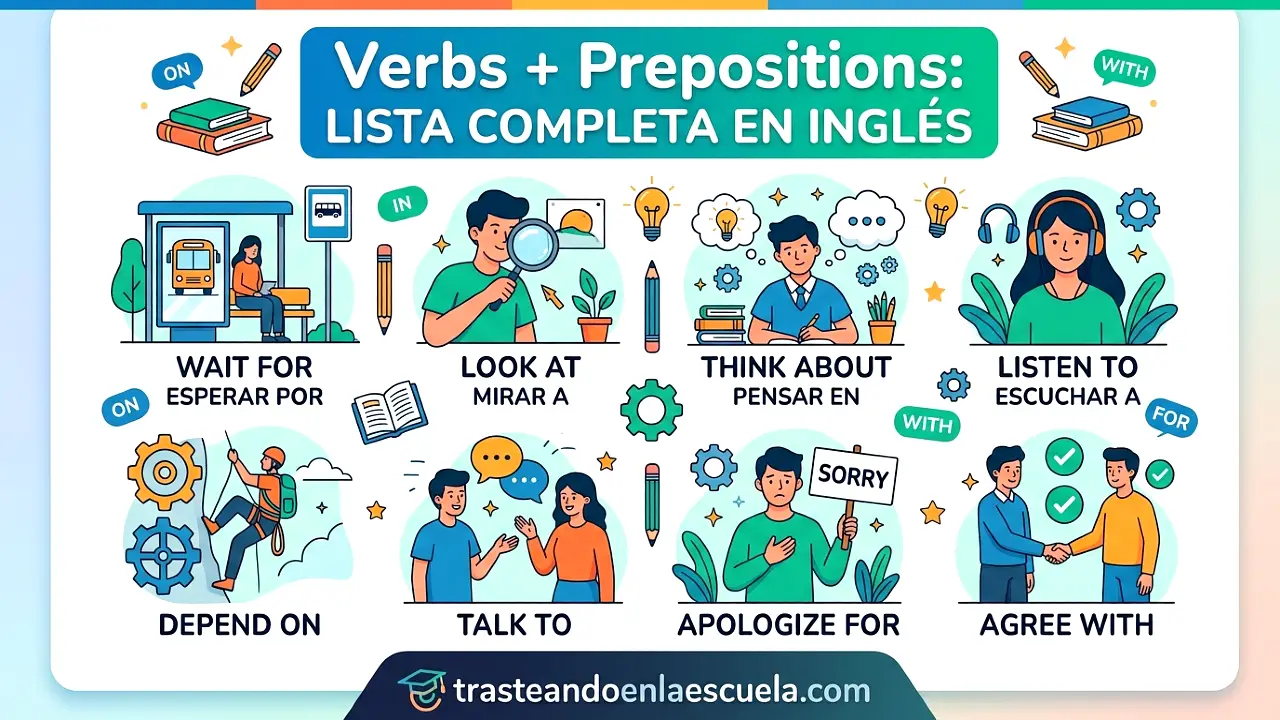
Verbs + Prepositions: La guía definitiva
Uno de los mayores desafíos para los estudiantes de inglés es aprender qué preposición va después de cada verbo. ¿Se dice «wait for» o «wait to»? ¿»think about» o «think of»? En esta guía completa recopilamos las combinaciones más importantes, organizadas por frecuencia de uso y con ejemplos claros.
🎯 En este post aprenderás: Más de 50 combinaciones verbo + preposición, su significado exacto, ejemplos de uso en contexto, y trucos para distinguir las más difíciles. Además, al final encontrarás un enlace a nuestra sección de ejercicios específicos para practicar.
🔍 ¿Por qué es importante aprenderlas?
En español, muchas veces usamos una preposición diferente para el mismo verbo, o directamente no usamos ninguna. Por eso, los hispanohablantes tendemos a cometer errores como «I wait you» en lugar de «I wait for you».
La preposición cambia completamente el significado del verbo, como veremos con look en nuestro post sobre Look at, for, after. Un pequeño error puede hacer que tu frase sea confusa o incorrecta.
📊 Lista completa por orden alfabético
| Verbo + Preposición | Significado | Ejemplo |
|---|---|---|
| Account for | Explicar, dar razón de | His story accounts for the missing money. |
| Agree with | Estar de acuerdo con (alguien) | I completely agree with you. |
| Agree on | Acordar (un tema/plan) | We agreed on a price. |
| Apologize for | Disculparse por | He apologized for being late. |
| Apply for | Solicitar (trabajo, beca) | She applied for the job. |
| Ask for | Pedir algo | He asked for a coffee. |
| Ask about | Preguntar acerca de | She asked about your health. |
| Believe in | Creer en (algo/alguien) | I believe in ghosts / I believe in you. |
| Belong to | Pertenecer a | This book belongs to Maria. |
| Blame for | Culpar de/por | They blamed me for the accident. |
| Blame on | Echar la culpa a | She blamed the accident on me. |
| Care about | Importar, preocuparse por | I really care about the environment. |
| Care for | Cuidar a / gustar (formal) | She cares for her elderly mother. |
| Compare to | Comparar (para señalar similitudes) | Shakespeare compared love to a summer’s day. |
| Compare with | Comparar (para analizar diferencias) | Let’s compare the results with last year’s. |
| Complain about | Quejarse de | They complained about the food. |
| Concentrate on | Concentrarse en | Please concentrate on your work. |
| Congratulate on | Feliciar por | I congratulated her on her promotion. |
| Consist of | Consistir en | Water consists of hydrogen and oxygen. |
| Count on | Contar con (confiar en) | You can count on me. |
| Depend on | Depender de | It depends on the weather. |
| Deal with | Tratar con, lidiar con | She deals with customer complaints. |
| Dream about | Soñar con (mientras duermes) | I dreamt about you last night. |
| Dream of | Soñar con (aspirar a) | He dreams of becoming a doctor. |
| Feel like | Tener ganas de | I feel like going to the cinema. |
| Forget about | Olvidarse de | Let’s forget about our problems. |
| Happen to | Suceder a | What happened to you? |
| Hear about | Oír sobre (recibir información) | Did you hear about the accident? |
| Hear from | Recibir noticias de alguien | I haven’t heard from him in weeks. |
| Hear of | Saber de la existencia de | Have you ever heard of that author? |
| Hope for | Esperar (algo positivo) | Let’s hope for good weather. |
| Insist on | Insistir en | He insisted on paying the bill. |
| Interfere with | Interferir en | Don’t let emotions interfere with your judgment. |
| Laugh at | Reírse de | They laughed at his joke. |
| Listen to | Escuchar | Listen to this song! |
| Look at | Mirar | Look at that sunset. |
| Look for | Buscar | I’m looking for my keys. |
| Look after | Cuidar | She looks after her little brother. |
| Pay for | Pagar algo | I’ll pay for dinner. |
| Prevent from | Prevenir de, evitar | Nothing will prevent me from going. |
| Protect from | Proteger de | Sunscreen protects you from the sun. |
| Provide with | Proveer de | The school provides students with books. |
| Refer to | Referirse a | What are you referring to? |
| Rely on | Confiar en, depender de | You can rely on him. |
| Remind of | Recordar a (parecerse) | She reminds me of my sister. |
| Search for | Buscar (minuciosamente) | They searched for survivors. |
| Speak to/with | Hablar con | I need to speak to you. |
| Succeed in | Tener éxito en | She succeeded in passing the exam. |
| Take care of | Cuidar de, encargarse de | He takes care of the garden. |
| Talk about | Hablar sobre | Let’s talk about your future. |
| Think about | Pensar en (considerar, reflexionar) | I’m thinking about changing jobs. |
| Think of | Pensar en (opinar, recordar) | What do you think of this dress? / I can’t think of his name. |
| Wait for | Esperar a | I’ll wait for you at the station. |
| Worry about | Preocuparse por | Don’t worry about me. |
💡 Truco de estudio: No intentes memorizar toda la lista de una vez. Agrupa los verbos por preposición (todos los que usan «for», luego «about», etc.) o por tema (verbos de comunicación, de sentimiento…). Así tu cerebro crea conexiones más fuertes.
🎯 Verbos que cambian de significado con la preposición
Algunos verbos cambian drásticamente su significado según la preposición que los acompañe. Aquí tienes los más importantes (puedes profundizar en los artículos dedicados a think about vs think of y a look at, for, after).
| Verbo | Con preposición | Significado | Ejemplo |
|---|---|---|---|
| Look | Look at | Mirar (dirigir la vista) | Look at this picture. |
| Look | Look for | Buscar | I’m looking for my phone. |
| Look | Look after | Cuidar | She looks after her grandmother. |
| Look | Look forward to | Esperar con ilusión | I look forward to meeting you. |
| Look | Look up to | Admirar | I look up to my father. |
| Look | Look down on | Menospreciar | She looks down on poor people. |
| Get | Get on | Subir a (vehículo) / llevarse bien | Get on the bus. / We get on well. |
| Get | Get off | Bajarse de | Get off the train. |
| Get | Get along with | Llevarse bien con | I get along with my colleagues. |
| Get | Get over | Superar (enfermedad, ruptura) | He’s getting over the flu. |
| Get | Get through | Pasar (una llamada) / superar | I can’t get through to her. |
| Run | Run into | Encontrarse con (casualmente) | I ran into an old friend. |
| Run | Run out of | Quedarse sin | We’ve run out of milk. |
| Run | Run over | Atropellar | The car ran over a cat. |
| Take | Take after | Parecerse a (físico o carácter) | She takes after her mother. |
| Take | Take care of | Cuidar | Take care of yourself. |
| Take | Take part in | Participar en | I want to take part in the competition. |
❌ Errores comunes de hispanohablantes
Error 1: «I wait you» ❌ → «I wait for you» ✅ (En español «esperar a», en inglés necesitas «for»)
Error 2: «I listen music» ❌ → «I listen to music» ✅ (El verbo «listen» siempre lleva «to»)
Error 3: «I ask a coffee» ❌ → «I ask for a coffee» ✅ («Ask for» es pedir algo, «ask» solo es preguntar)
Error 4: «I look her» ❌ → «I look at her» ✅ (Necesitas «at» para decir a quién miras)
Error 5: «I think in you» ❌ → «I think about/of you» ✅ (Nunca se usa «think in»)
Error 6: «I enter in the room» ❌ → «I enter the room» ✅ («Enter» no lleva preposición)
🧠 Ejercicios para practicar
Ejercicio 1: Completa con la preposición correcta
- I apologized ______ being late.
- She doesn’t believe ______ ghosts.
- Please, listen ______ me.
- Who does this book belong ______?
- He insisted ______ paying for dinner.
- We’re waiting ______ the bus.
- She always worries ______ money.
- I can’t concentrate ______ my work with this noise.
- They complained ______ the service.
- You can count ______ me.
✅ Ver soluciones
1. for | 2. in | 3. to | 4. to | 5. on | 6. for | 7. about | 8. on | 9. about | 10. on
Ejercicio 2: Elige la opción correcta
- I’m looking at / for / after my keys. I can’t find them anywhere.
- She looks at / for / after her little sister while their parents work.
- Look at / for / after this photo! It’s beautiful.
- What are you thinking about / of? You seem worried.
- What do you think about / of my new haircut?
- I’m thinking about / of moving to London.
- I need to pay for / to / at the tickets.
- He asked for / to / at a glass of water.
✅ Ver soluciones
1. looking for | 2. looks after | 3. Look at | 4. thinking about | 5. think of | 6. thinking about | 7. pay for | 8. asked for
Ejercicio 3: Traduce al inglés
- Depende del tiempo.
- ¿De qué te ríes?
- Cuento contigo.
- Ella se preocupa por sus hijos.
- Me recuerdas a mi hermana.
- ¿En qué estás pensando?
- Estoy buscando un nuevo trabajo.
- Ella cuida de su abuela.
✅ Ver soluciones
1. It depends on the weather. | 2. What are you laughing at? | 3. I count on you. | 4. She worries about her children. | 5. You remind me of my sister. | 6. What are you thinking about? | 7. I’m looking for a new job. | 8. She looks after her grandmother.
Ejercicio 4: Corrige los errores
Las siguientes frases tienen errores. Escríbelas correctamente:
- I agree you.
- She asked a question to the teacher.
- We discussed about the problem.
- He entered in the room.
- I explained him the situation.
- She married with a doctor.
- I paid the dinner.
- He phoned to his mother.
✅ Ver soluciones
1. I agree with you. | 2. She asked the teacher a question. | 3. We discussed the problem. (sin «about») | 4. He entered the room. (sin «in») | 5. I explained the situation to him. | 6. She married a doctor. (sin «with») | 7. I paid for the dinner. | 8. He phoned his mother. (sin «to»)
Ejercicio 5: Completa el texto
Rellena los huecos con las preposiciones correctas (at, for, after, about, of, on, with, to).
Yesterday, I was looking _____ my phone when I realized I had left it in the car. I asked my brother _____ help, but he was busy. He told me to wait _____ him, but I didn’t want to. I thought _____ calling my friend, but then I remembered that my phone was in the car! I went to the car and looked _____ it. Finally, I found it under the seat. I was so relieved! Later, I talked _____ my brother _____ what had happened. He laughed _____ me because it was a silly mistake.
✅ Ver soluciones
for, for, for, about, for, to, about, at
📖 Recursos relacionados
📚 Serie completa: Preposiciones después de Verbos
Continúa aprendiendo sobre este tema fundamental del inglés:
- Verbs + prepositions: lista completa – ¡Estás aquí!
- Look at, look for, look after: diferencias – Domina los phrasal verbs con «look».
- Wait for, ask for, pay for: usos y ejemplos – Verbos comunes con «for».
- Think about vs think of: diferencias clave – Aprende a distinguirlos.
- Ejercicios verbos + preposiciones – Practica todo lo aprendido.
📌 Checklist para tu estudio
- He leído y entendido la lista completa de verbos.
- He identificado los 10 verbos que más me cuestan.
- He hecho al menos 3 de los 5 ejercicios.
- He escrito mis propias frases con los verbos difíciles.
- He visitado los enlaces a los artículos relacionados.
🚀 Siguiente paso: Ahora que tienes la teoría, ponla en práctica con nuestros ejercicios específicos. La práctica activa es la única forma de interiorizar estas combinaciones.






Publicar comentario