Presente con valor de futuro en inglés: guía y ejemplos
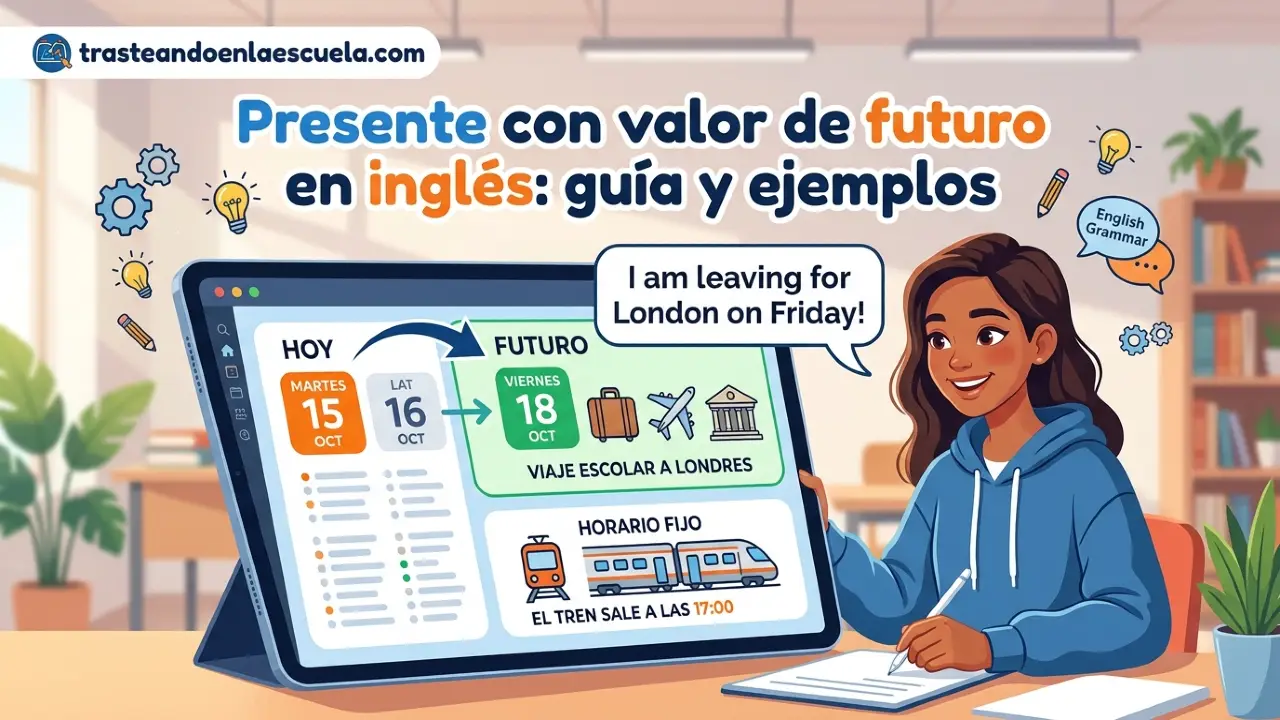
Presente con valor de futuro: Cuando el futuro ya está fijado
En español, decimos «El tren sale a las 5 de la tarde» o «Mañana voy al dentista». Usamos el presente para hablar de un futuro que está programado. En inglés ocurre exactamente lo mismo, y no usar «will» o «going to» en estos casos es señal de un inglés avanzado y natural.
🎯 En este post aprenderás: Cuándo usar el Present Simple para horarios fijos (timetables) y el Present Continuous para planes personales ya acordados (arrangements), las diferencias con will y going to, y ejercicios para practicar.
🔍 ¿Qué significa «presente con valor de futuro»?
🗓️ El futuro que ya está en la agenda
En inglés, usamos los tiempos presentes (Present Simple y Present Continuous) para hablar de eventos futuros que ya están confirmados, programados o acordados. No son predicciones ni decisiones espontáneas, son hechos futuros.
Hay dos situaciones principales:
- Present Simple: Para horarios oficiales, programas, itinerarios (timetables).
- Present Continuous: Para planes personales ya decididos y acordados con otras personas (arrangements).
📋 1. Present Simple para horarios fijos (Timetables)
🚂 Uso: Transporte, espectáculos, clases, etc.
Usamos el Present Simple para hablar de eventos que siguen un horario fijo, como los que publican las compañías de tren, autobús, avión, cines, teatros, etc. Estos eventos no dependen de nuestra voluntad.
Ejemplos:
- The train to Madrid leaves at 9 pm tonight. (El tren a Madrid sale a las 9 de esta noche.)
- The conference starts next Monday. (La conferencia empieza el próximo lunes.)
- What time does the film begin? (¿A qué hora empieza la película?)
- My English course finishes in June. (Mi curso de inglés termina en junio.)
- When does the next bus arrive? (¿Cuándo llega el próximo autobús?)
💡 Palabras clave: Suele ir acompañado de expresiones de tiempo futuro como tonight, tomorrow, next week, on Friday, at 5 pm, in July.
📋 2. Present Continuous para planes personales (Arrangements)
👥 Uso: Planes con otras personas, citas
Usamos el Present Continuous para hablar de planes personales que ya hemos organizado con otras personas. Normalmente implican un lugar, una hora y a menudo un acuerdo con alguien.
Ejemplos:
- I ‘m meeting my friends for dinner tonight. (Quedo con mis amigos para cenar esta noche.)
- She ‘s having lunch with her boss tomorrow. (Ella come con su jefe mañana.)
- We ‘re flying to Paris next weekend. (Volamos a París el próximo fin de semana.)
- Are you doing anything on Saturday? (¿Haces algo el sábado?)
- He isn’t coming to the party because he’s working. (Él no viene a la fiesta porque está trabajando.)
📊 Comparativa: Todas las formas de futuro
| Forma | Uso principal | Ejemplo | ¿Planificado? |
|---|---|---|---|
| Present Simple | Horarios fijos (timetables) | The plane leaves at 8. | ✅ (Oficial) |
| Present Continuous | Planes personales acordados | I ‘m meeting Sue. | ✅ (Personal) |
| Going to | Intenciones, planes generales, evidencia | I ‘m going to buy a car. | ✅ (Intención) |
| Will | Decisiones espontáneas, predicciones, promesas | I ‘ll help you. | ❌ (Espontáneo) |
🧪 5 Ejercicios prácticos: Presente con valor de futuro
Ejercicio 1: Present Simple o Present Continuous?
Elige la opción correcta para cada oración (hablando del futuro).
- The train __________ (leave / is leaving) at 7 am tomorrow.
- I __________ (have / ‘m having) dinner with my parents this evening.
- What time __________ (does the film start / is the film starting)?
- We __________ (go / are going) to the cinema on Friday. Do you want to join?
- The next semester __________ (begins / is beginning) on September 1st.
✅ Ver solución
- leaves (Present Simple: horario fijo de tren).
- ‘m having (Present Continuous: plan personal acordado).
- does the film start (Present Simple: pregunta por horario de cine).
- are going (Present Continuous: plan personal con amigos).
- begins (Present Simple: fecha fija del calendario académico).
Ejercicio 2: Completa con el verbo en la forma correcta
Completa las oraciones con el Present Simple o Present Continuous de los verbos. Todas las oraciones se refieren al futuro.
- My sister __________ (get married) next June.
- The concert __________ (not/start) until 9 pm.
- __________ you __________ (come) to the party on Saturday?
- The last train to the city __________ (depart) at 11:30 pm.
- I __________ (not/work) tomorrow, so we can go to the beach.
✅ Ver solución
- is getting married (Present Continuous: plan personal/evento).
- doesn’t start (Present Simple: horario).
- Are you coming (Present Continuous: pregunta por plan).
- departs (Present Simple: horario).
- ‘m not working (Present Continuous: plan personal).
Ejercicio 3: Elige la opción más natural
Selecciona la opción que suena más natural en inglés.
- A: «Are you free on Friday?» B: «Sorry, I __________ (will see / am seeing) the doctor.»
- According to the timetable, the bus to Oxford __________ (will leave / leaves) at 10:15.
- I can’t believe it! Next year we __________ (are celebrating / will celebrate) our 10th anniversary.
- Look at the sky! It __________ (is raining / ‘s going to rain).
- What time __________ (does the match start / is the match starting) tonight?
✅ Ver solución
- am seeing (Present Continuous para cita planificada).
- leaves (Present Simple para horario).
- are celebrating (Present Continuous para un evento planificado).
- ‘s going to rain (Predicción basada en evidencia, no es un horario).
- does the match start (Present Simple para evento con horario fijo).
Ejercicio 4: Reescribe usando presente con valor de futuro
Reescribe las oraciones usando el Present Simple o Present Continuous.
- We have a plan to visit the museum tomorrow. → We __________ the museum tomorrow.
- The train is scheduled to arrive at 6 pm. → The train __________ at 6 pm.
- She has an appointment with the dentist on Monday. → She __________ the dentist on Monday.
- The store’s opening hours say it opens at 9 am. → The store __________ at 9 am.
- My friends and I have arranged to play tennis later. → I __________ tennis later with my friends.
✅ Ver solución
- are visiting
- arrives
- is seeing (o ‘s going to the dentist)
- opens
- am playing
Ejercicio 5: Completa el diálogo
Completa el diálogo con los verbos en Present Simple o Present Continuous.
A: What __________ you __________ (do) this weekend?
B: I __________ (go) to a music festival with my cousin. The festival __________ (start) on Friday and __________ (finish) on Sunday.
A: Sounds fun! What time __________ the first band __________ (play)?
B: They __________ (go) on stage at 6 pm on Friday.
A: And __________ you __________ (camp) there?
B: Yes, we __________ (stay) in a tent for the weekend.
✅ Ver solución
A: What are you doing this weekend?
B: I ‘m going to a music festival with my cousin. The festival starts on Friday and finishes on Sunday.
A: Sounds fun! What time does the first band play?
B: They go on stage at 6 pm on Friday.
A: And are you camping there?
B: Yes, we ‘re staying in a tent for the weekend.
❌ Errores comunes
| Error | Ejemplo incorrecto | Corrección | Explicación |
|---|---|---|---|
| Usar «will» para horarios | The train will leave at 8 tomorrow. | The train leaves at 8 tomorrow. | Para horarios fijos, el Present Simple es más natural y común. |
| Usar Present Simple para planes personales | I meet my friends tonight. | I ‘m meeting my friends tonight. | Los planes personales con otras personas requieren Present Continuous. |
| Olvidar la expresión de tiempo | I’m going to the cinema. (sin tiempo futuro) | I’m going to the cinema tonight. | Para que se entienda que es futuro, a menudo necesitas un marcador temporal. |
| Usar Present Continuous para eventos fuera de control personal | The sun is rising at 6 am tomorrow. | The sun rises at 6 am tomorrow. | Los eventos naturales o astronómicos se tratan como horarios fijos (Present Simple). |
📚 Serie completa: El Futuro en Inglés
Este post es el cuarto de la serie. Repasa los anteriores y prepárate para el último:
- Will vs Going to: diferencias definitivas
- Future Continuous: cómo y cuándo usarlo
- Future Perfect: guía completa
- Presente con valor de futuro – ¡Estás aquí!
- Ejercicios futuro inglés con soluciones – El reto final.
🏆 Truco final: Para saber si usar Present Simple o Present Continuous para el futuro, pregúntate: ¿Es un horario público (tren, cine, clase) -> Present Simple. ¿Es un plan que he organizado con alguien (cita, quedar con amigos) -> Present Continuous.


Publicar comentario