Take care of, take part in, take place: phrasal verbs para situaciones cotidianas
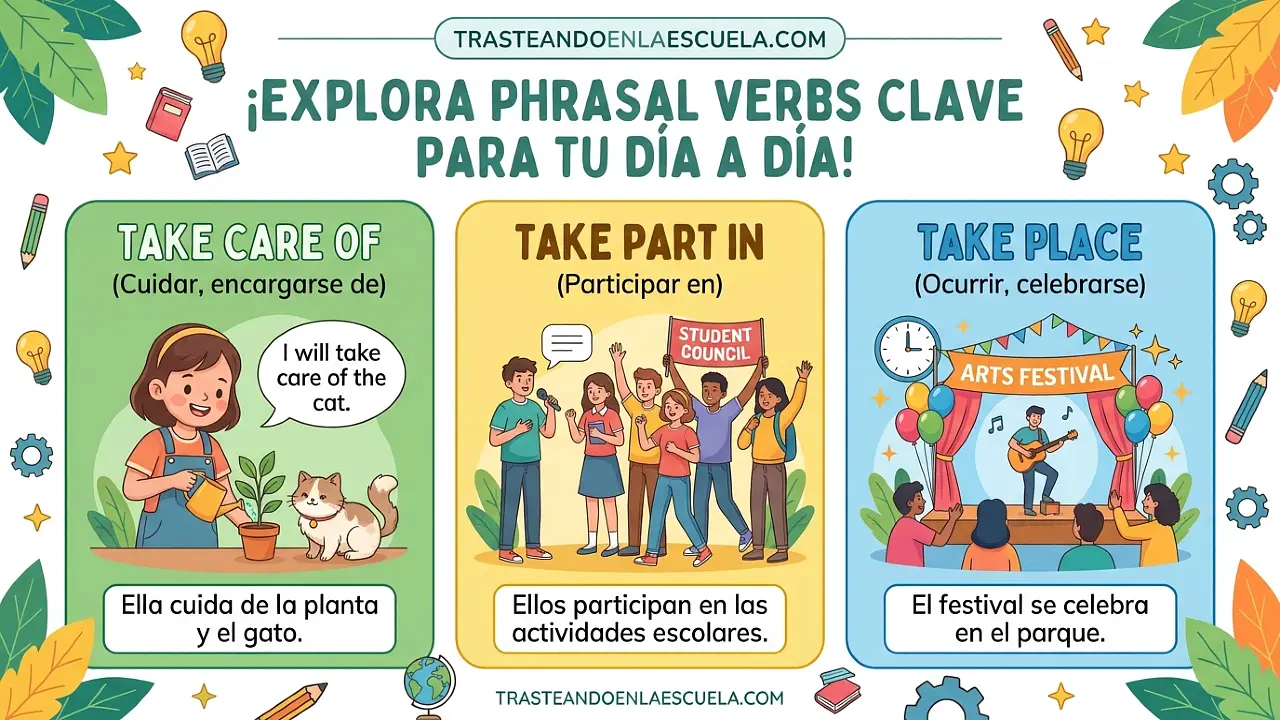
Take care of, take part in, take place: tus aliados para situaciones cotidianas
¿Necesitas hablar de cuidar a alguien, participar en un evento o decir dónde ocurre algo? Los phrasal verbs «take care of», «take part in» y «take place» son esenciales para tu vocabulario diario. Son de esos verbos que escucharás y usarás constantemente, desde una conversación con amigos hasta en el ámbito profesional.
🎯 En este post aprenderás: El significado de estos tres phrasal verbs, su estructura gramatical, ejemplos en diferentes contextos, la diferencia entre ellos y ejercicios para que los integres a tu inglés.
📌 Take care of: Cuidar y ocuparse
🎯 Significados de «Take care of»
1. CUIDAR DE ALGUIEN/ALGO
Significado: Ser responsable de la seguridad o bienestar de alguien o algo.
Ejemplo: She takes care of her elderly parents.
(Ella cuida de sus padres mayores.)
2. OCUPARSE DE / RESOLVER (un problema)
Significado: Hacerse cargo de una tarea o resolver un asunto.
Ejemplo: Don’t worry, I’ll take care of the bill.
(No te preocupes, yo me ocupo de la cuenta.)
📝 Estructura gramatical
Take care of + sustantivo/pronoun
Este phrasal verb siempre va acompañado de un objeto. Es inseparable.
📝 Más ejemplos
- Can you take care of the dog while I’m on vacation?
- She takes care of all the administrative tasks.
- I’ll take care of it immediately.
💡 Truco para recordar «Take care of»: «Care» es cuidado. Si «tomas cuidado» de algo, lo cuidas. Es el phrasal verb para mostrar responsabilidad y afecto.
📌 Take part in: Participar activamente
🎯 Significado de «Take part in»
PARTICIPAR EN / TOMAR PARTE EN
Significado: Involucrarse en una actividad, evento o competición.
Ejemplo: Hundreds of students took part in the demonstration.
(Cientos de estudiantes participaron en la manifestación.)
📝 Estructura gramatical
Take part in + actividad/evento
Es inseparable. Siempre va seguido de «in» y el objeto de la participación.
📝 Más ejemplos
- Are you going to take part in the marathon?
- She decided not to take part in the competition.
- I love taking part in charity events.
💡 Diferencia con «participate»: «Take part in» es más informal y coloquial que «participate». En conversaciones diarias, es la opción más natural.
📌 Take place: Ocurrir o tener lugar
🎯 Significado de «Take place»
OCURRIR / TENER LUGAR
Significado: Referirse a cuándo o dónde sucede un evento.
Ejemplo: The concert will take place at the stadium.
(El concierto tendrá lugar en el estadio.)
📝 Estructura gramatical
Take place (sin objeto directo)
Es un phrasal verb intransitivo. No lleva objeto. Se usa como «occur» o «happen».
📝 Más ejemplos
- The wedding took place on a sunny day in June.
- Where will the meeting take place?
- Great changes have taken place in the last decade.
💡 Truco para recordar «Take place»: «Place» es lugar. Un evento «toma un lugar» en el tiempo o espacio, es decir, ocurre.
📊 Tabla comparativa: Estructura y uso
| Phrasal Verb | Estructura | Uso | Ejemplo |
|---|---|---|---|
| Take care of | + objeto | Cuidar / Ocuparse | She takes care of the children. |
| Take part in | + in + actividad | Participar | He took part in the race. |
| Take place | sin objeto | Ocurrir | The event took place yesterday. |
🧪 5 Ejercicios para dominar Take care of, Take part in y Take place
Ejercicio 1: Elige el phrasal verb correcto
Completa las oraciones con «take care of», «take part in» o «take place».
- The annual conference will __________ in Madrid.
- I need someone to __________ my plants while I’m away.
- Are you going to __________ the singing competition?
- Don’t worry about dinner, I’ll __________ it.
- The accident __________ at the intersection of Main Street and 5th Avenue.
✅ Ver solución
- take place
- take care of
- take part in
- take care of
- took place
Ejercicio 2: Completa las oraciones con la palabra correcta
Completa con «care», «part» o «place».
- Who will take __________ of the children?
- Thousands of people took __________ in the protest.
- The ceremony will take __________ in the main hall.
- I can take __________ of the travel arrangements.
- Would you like to take __________ in our survey?
✅ Ver solución
- care
- part
- place
- care
- part
Ejercicio 3: Traduce al inglés
Traduce las siguientes frases al inglés usando los phrasal verbs correctos.
- Mi hermana cuida de mis gatos cuando viajo.
- El partido tendrá lugar el sábado.
- Muchos estudiantes participaron en el debate.
- Yo me encargo de las compras.
- La reunión ocurrió sin problemas.
✅ Ver solución
- My sister takes care of my cats when I travel.
- The game will take place on Saturday.
- Many students took part in the debate.
- I will take care of the shopping.
- The meeting took place without any issues.
Ejercicio 4: Identifica el error y corrige
Algunas oraciones tienen un error. Identifícalo y corrígelo.
- The festival will take part in the city center.
- I will take care the dog while you are gone.
- She took part of the marathon last year.
- Please, take care of the details for me.
- Where will the event take care of?
✅ Ver solución
- Error: «take part in» → Corrección: «take place» (The festival will take place in the city center.)
- Error: «take care» → Corrección: «take care of» (I will take care of the dog…)
- Error: «took part of» → Corrección: «took part in» (She took part in the marathon…)
- Correcta
- Error: «take care of» → Corrección: «take place» (Where will the event take place?)
Ejercicio 5: Crea tus propias oraciones
Escribe una oración original usando cada phrasal verb.
- Take care of:
- Take part in:
- Take place:
✅ Ver soluciones de ejemplo
- I need to take care of my health.
- I would love to take part in a play.
- The movie premiere will take place next week.
📚 Serie completa: Phrasal Verbs con TAKE
Sigue practicando con los siguientes posts de la serie:
- Take off, take on, take over – Verbos para cambios y retos.
- Take care of, take part in, take place – ¡Estás aquí!
- Take after vs look like – Cómo hablar del parecido.
- Take in, take out, take away – Verbos para acciones cotidianas.
- 40 phrasal verbs con TAKE (lista PDF) – El resumen definitivo.






Publicar comentario