Future Perfect: guía completa para usarlo en inglés
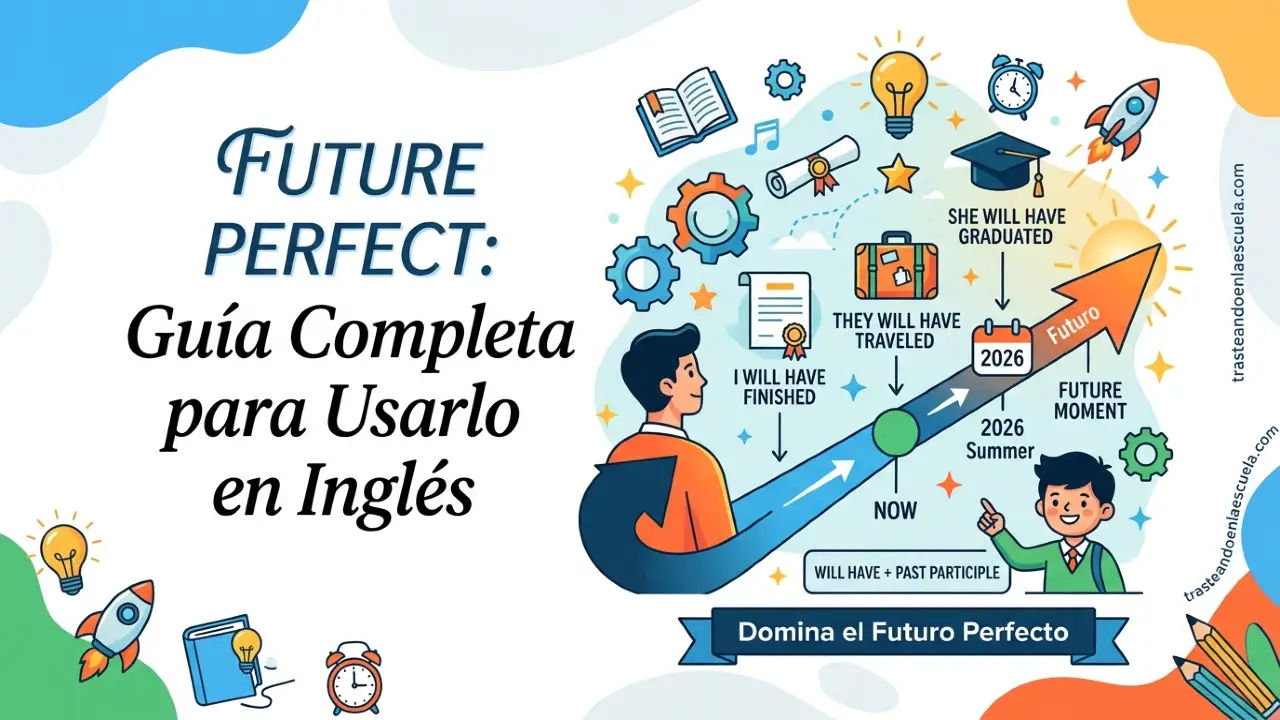
Future Perfect: La acción que «habrá terminado»
Imagina que tienes un proyecto que entregar el viernes. El miércoles, un colega te pregunta si estarás libre el jueves para una reunión. Quieres decirle que para el jueves ya habrás terminado el proyecto. En inglés, necesitas el Future Perfect: «By Thursday, I will have finished the project». Este tiempo mira al futuro desde un punto en el futuro, como si pudiéramos viajar en el tiempo y ver una acción ya completada.
🎯 En este post aprenderás: La estructura del Future Perfect (will have + participio pasado), su uso principal (acciones completadas antes de un momento futuro), cómo usarlo con «by», «by the time», y ejemplos claros con ejercicios prácticos.
🔍 ¿Qué es el Future Perfect?
📅 Una acción terminada en un momento del futuro
El Future Perfect se usa para hablar de una acción que habrá terminado (o estará completada) antes de un momento determinado en el futuro. Ese momento futuro puede ser una hora específica, una fecha, o incluso otra acción.
📅 Línea temporal del Future Perfect
AHORA → → → FECHA LÍMITE (EJ: VIERNES) → → →
🔹🔹 (TRABAJANDO) 🔹🔹 | 🔹🔹 | ✔️ ACCIÓN TERMINADA
By Friday, I will have finished the project. (Para el viernes, habré terminado el proyecto.)
Es el equivalente futuro del Present Perfect (I have finished) y del Past Perfect (I had finished).
📋 Estructura del Future Perfect
NEGATIVA: SUJETO + WILL NOT HAVE (WON’T HAVE) + PARTICIPIO PASADO
INTERROGATIVA: WILL + SUJETO + HAVE + PARTICIPIO PASADO?
Ejemplos de cada forma:
- Afirmativa: By the time you arrive, I will have cooked dinner. (Para cuando llegues, ya habré cocinado la cena.)
- Negativa: She won’t have finished the report by 5 pm. (Ella no habrá terminado el informe para las 5 pm.)
- Interrogativa: Will you have completed the course by June? (¿Habrás completado el curso para junio?)
💡 Importante: El participio pasado de los verbos regulares termina en -ed (finished, worked, started). Los irregulares tienen formas propias (done, been, had, eaten, written, etc.).
🧠 Cuándo usar el Future Perfect
1. Acciones completadas antes de un momento futuro
Es el uso principal. Siempre va acompañado de una expresión de tiempo que marca el límite: by (para), by the time (para cuando), before (antes de que).
- I will have saved enough money by the end of the year. (Habré ahorrado suficiente dinero para fin de año.)
- They will have built the new bridge by 2026. (Habrán construido el nuevo puente para 2026.)
- By the time we get to the cinema, the film will have started. (Para cuando lleguemos al cine, la película habrá empezado.)
- He won’t have left for work before 8 am. (No se habrá ido a trabajar antes de las 8 am.)
2. Para hablar de la duración de una acción hasta un punto futuro
Al igual que el Present Perfect, podemos usarlo para decir cuánto tiempo habrá durado algo en un punto futuro. A menudo con for.
- Next month, I will have been in this company for 10 years. (El mes que viene, habré estado en esta empresa durante 10 años.)
- On Friday, we will have known each other for exactly 5 years. (El viernes, nos habremos conocido durante exactamente 5 años.)
3. Para hacer suposiciones sobre el pasado reciente (desde el presente)
A veces, el Future Perfect se usa para expresar certeza o suposición sobre algo que ya ha ocurrido en el pasado cercano, especialmente con adverbios como «already». Es como un «must have» en pasado.
- Don’t worry, he will have arrived home by now. (No te preocupes, ya habrá llegado a casa a estas alturas.)
- She will have already heard the news. (Ella ya se habrá enterado de la noticia.)
📊 Comparación: Future Perfect vs Future Simple
| Característica | Future Simple (will do) | Future Perfect (will have done) |
|---|---|---|
| Qué describe | Acción que ocurrirá en el futuro. | Acción que ya habrá ocurrido antes de un momento futuro. |
| Perspectiva | Desde el presente hacia el futuro. | Desde un punto en el futuro mirando hacia atrás. |
| Ejemplo con «by» | I will finish it by Friday. (Lo terminaré el viernes, quizás justo ese día). | I will have finished it by Friday. (Lo tendré terminado antes o como muy tarde el viernes). |
⏰ Expresiones de tiempo comunes
📅 Preposiciones
- by + momento (by 5 pm, by Friday, by next week)
- before + momento/acción (before you leave)
- by the time + oración (by the time we arrive)
📅 Adverbios
- already (ya)
- just (acabar de)
- yet (aún, en negativas)
- by then (para entonces)
🧪 5 Ejercicios prácticos con Future Perfect
Ejercicio 1: Completa con la forma afirmativa
Completa las oraciones usando el Future Perfect de los verbos entre paréntesis.
- By 10 pm, I __________ (finish) my homework.
- They __________ (build) the house by the end of the year.
- She __________ (save) enough money for a car by July.
- By the time you wake up, I __________ (leave) for work.
- We __________ (eat) all the food by the time the guests arrive.
✅ Ver solución
- will have finished
- will have built
- will have saved
- will have left
- will have eaten
Ejercicio 2: Forma negativa
Escribe las siguientes oraciones en negativo usando el Future Perfect.
- She / finish / the report / by Monday.
- I / see / that movie / by the end of the week.
- They / arrive / before midnight.
- He / learn / all the verbs / by tomorrow.
- We / complete / the project / by Friday.
✅ Ver solución
- She won’t have finished the report by Monday.
- I won’t have seen that movie by the end of the week.
- They won’t have arrived before midnight.
- He won’t have learned all the verbs by tomorrow.
- We won’t have completed the project by Friday.
Ejercicio 3: Preguntas
Formula preguntas con el Future Perfect.
- you / finish / the book / by next week?
- she / arrive / by 8 pm?
- they / build / the bridge / by 2025?
- he / save / enough money / by June?
- we / eat / all the food / before they come?
✅ Ver solución
- Will you have finished the book by next week?
- Will she have arrived by 8 pm?
- Will they have built the bridge by 2025?
- Will he have saved enough money by June?
- Will we have eaten all the food before they come?
Ejercicio 4: Elige la opción correcta
Selecciona Future Simple o Future Perfect.
- Don’t call me at 6 pm because I __________ (not/finish) work yet.
- I promise I __________ (call) you when I arrive.
- By the time you get home, I __________ (clean) the whole house.
- I think it __________ (rain) tomorrow.
- Next year, we __________ (be) married for 15 years.
✅ Ver solución
- won’t have finished (Future Perfect: para las 6, la acción de terminar no estará completada).
- will call (Future Simple: promesa).
- will have cleaned (Future Perfect: la acción estará completada para cuando llegues).
- will rain (Future Simple: predicción).
- will have been (Future Perfect: duración hasta un punto futuro).
Ejercicio 5: Reescribe las oraciones
Reescribe las siguientes oraciones usando el Future Perfect con «by».
- I will finish the project. (Friday) → _________________________________
- She will leave. (the time you get here) → _________________________________
- They will sell all the tickets. (the end of the week) → _________________________________
- He won’t learn to drive. (summer) → _________________________________
- Will you read the book? (tomorrow) → _________________________________
✅ Ver solución
- I will have finished the project by Friday.
- She will have left by the time you get here.
- They will have sold all the tickets by the end of the week.
- He won’t have learned to drive by summer.
- Will you have read the book by tomorrow?
❌ Errores comunes
| Error | Ejemplo incorrecto | Corrección | Explicación |
|---|---|---|---|
| Olvidar «have» | I will finished by Friday. | I will have finished by Friday. | El Future Perfect necesita «will have + participio», no «will + participio». |
| Usar el participio incorrecto | She will have went home. | She will have gone home. | «Went» es pasado simple. El participio de «go» es «gone». |
| Confundir «by» con «until» | I will have finished it until Friday. | I will have finished it by Friday. | «Until» se usa para acciones continuas (I will wait until Friday). «By» marca el límite para una acción completada. |
📚 Serie completa: El Futuro en Inglés
Este post forma parte de nuestra serie sobre el futuro. No te pierdas los demás:
- Will vs Going to: diferencias definitivas
- Future Continuous: cómo y cuándo usarlo
- Future Perfect: guía completa – ¡Estás aquí!
- Presente con valor de futuro
- Ejercicios futuro inglés con soluciones
🏆 Truco final: Piensa en el Future Perfect como el «habré» del español. Si en tu frase en español usas «habré», «habrás», «habrá» + participio, en inglés necesitas «will have» + participio. Por ejemplo: «Para el lunes lo habré terminado» = «By Monday I will have finished it».

Publicar comentario