Phrasal Verbs con CARRY: carry on, carry out, carry over
Phrasal Verbs con CARRY: La guía definitiva
El verbo «carry» significa «llevar» o «transportar», pero cuando le añadimos pequeñas partículas, su significado cambia por completo. En este post, vamos a dominar tres de los phrasal verbs con «carry» más útiles en inglés: carry on, carry out y carry over. Aprenderás cuándo usar cada uno, cómo estructurarlos correctamente y verás ejemplos en contextos reales.
🎯 En este post aprenderás: Los significados de carry on (continuar), carry out (realizar/ejecutar) y carry over (transferir/posponer), sus estructuras gramaticales, diferencias clave, y 5 ejercicios prácticos para consolidar tu aprendizaje.
🔍 ¿Qué son los phrasal verbs con «carry»?
📦 La esencia de «carry» en acción
El verbo principal «carry» ya implica movimiento o transporte. Al añadir las partículas «on», «out» y «over», el significado se extiende desde lo físico hacia lo abstracto, cubriendo ideas como continuar una acción, ejecutar una tarea o trasladar algo a otro momento o lugar.
🏭 La analogía de la línea de producción
Imagina una fábrica:
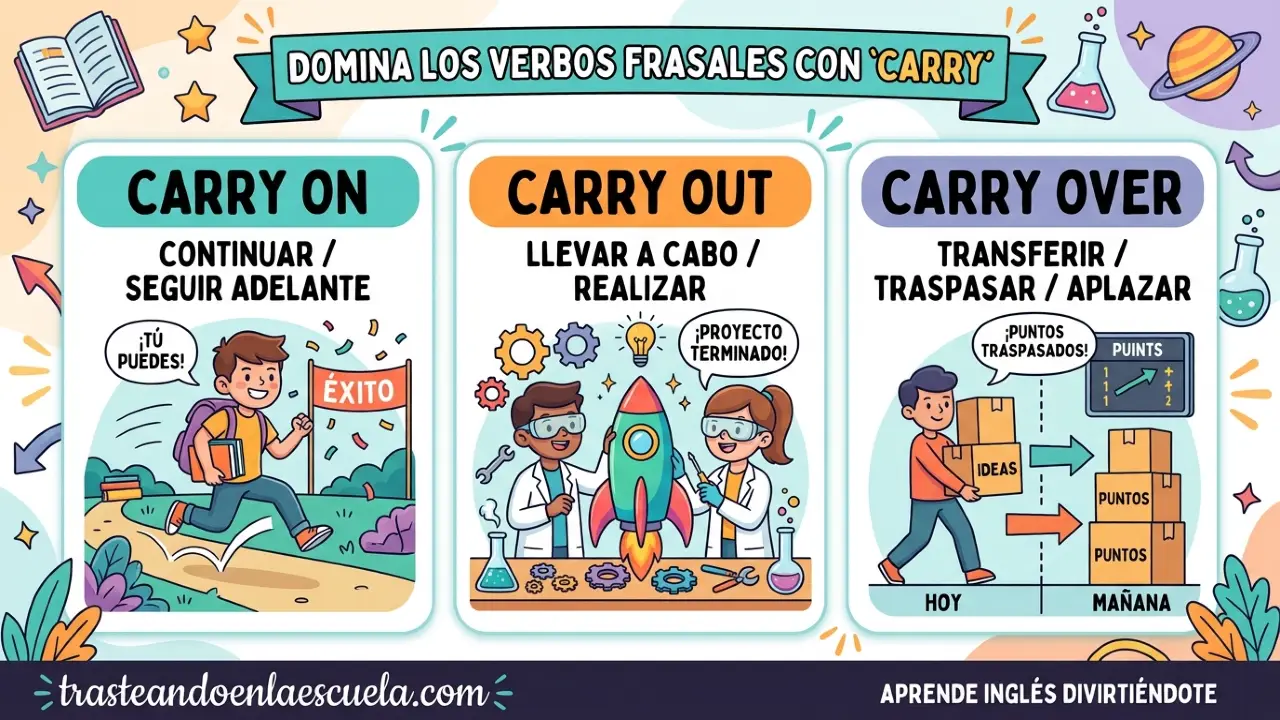
- CARRY ON: La máquina sigue funcionando sin parar (continuar).
- CARRY OUT: Un trabajador ejecuta un plan de producción (realizar).
- CARRY OVER: Las órdenes no terminadas se pasan al siguiente turno (transferir).
1. CARRY ON: Continuar o seguir haciendo algo
🎯 Significado y estructura
Se usa para indicar que una acción no se detiene. Puede usarse solo o seguido de «with» + sustantivo o «gerundio».
📝 Estructuras comunes:
- carry on + (sin complemento): «Please carry on, don’t let me interrupt you.»
- carry on with + sustantivo: «She carried on with her work despite the noise.»
- carry on + gerundio (-ing): «He carried on talking even after the bell rang.»
💬 Ejemplos prácticos:
- «If the battery dies, the show will still carry on with a generator.»
- «The teacher told us to carry on with the exercise while she was out.»
- «I’m sorry I interrupted. Please carry on.»
- «They carried on arguing for hours after we left.»
- «Despite the difficulties, we must carry on with our plan.»
💡 Dato clave: «Carry on» es la versión informal de «continue». En contextos formales, es preferible usar «continue», pero en conversación cotidiana es muy común. Piensa en la famosa frase de la Segunda Guerra Mundial: «Keep calm and carry on».
2. CARRY OUT: Realizar, ejecutar o llevar a cabo
🎯 Significado y estructura
Este phrasal verb es fundamental en contextos profesionales y académicos. Implica ejecutar un plan, una orden, un experimento o una tarea específica.
📝 Estructura:
carry out + objeto (lo que se realiza)
Es un phrasal verb separable (podemos poner el objeto entre «carry» y «out», pero es más común y formal mantenerlo junto).
💬 Ejemplos prácticos:
- «The scientists carried out a series of experiments.»
- «We need to carry out the plan as soon as possible.»
- «The soldiers carried out their orders without hesitation.»
- «A survey was carried out to understand customer satisfaction.»
- «I have some errands to carry out this afternoon.»
💡 Dato clave: «Carry out» es el phrasal verb perfecto para el ámbito laboral. Puedes «carry out a task», «carry out a plan», «carry out research» o «carry out an order». En español, sería equivalente a «llevar a cabo» o «ejecutar».
3. CARRY OVER: Transferir, posponer o arrastrar
🎯 Significado y estructura
Este phrasal verb se usa cuando algo que no se completó se traslada a un nuevo contexto, tiempo o lugar. Es muy común en finanzas, gestión de proyectos y viajes.
📝 Estructura:
carry something over (to/into something) o carry over (intransitivo)
💬 Ejemplos prácticos:
- «The unused vacation days will carry over to next year.» (Los días de vacaciones no usados se trasladarán al próximo año.)
- «We need to carry over this discussion to the next meeting.» (Necesitamos posponer esta discusión para la próxima reunión.)
- «His bad habits from college carried over into his professional life.» (Sus malos hábitos de la universidad se trasladaron a su vida profesional.)
- «The budget surplus will carry over to the next fiscal year.»
- «The momentum from the first game carried over to the second.»
💡 Dato clave: En el contexto de vuelos, si pierdes tu vuelo, te pueden «carry over» el billete para otro día, aunque más comúnmente se dice «rebook». En el ámbito laboral, los temas no tratados en una reunión se «carry over» a la siguiente.
📊 Tabla comparativa: CARRY ON vs CARRY OUT vs CARRY OVER
| Phrasal Verb | Significado Principal | Uso común | Ejemplo |
|---|---|---|---|
| Carry on | Continuar | Acciones en progreso, conversaciones, trabajo | «Carry on with your homework.» |
| Carry out | Realizar / Ejecutar | Tareas, planes, órdenes, experimentos | «We carried out the plan successfully.» |
| Carry over | Transferir / Posponer | Días de vacaciones, temas de reuniones, saldos | «The points carry over to the next game.» |
⚠️ Errores comunes con CARRY
| Error | Ejemplo incorrecto | Corrección | Explicación |
|---|---|---|---|
| Confundir «carry on» con «carry out» | I need to carry on my homework. | I need to carry out my homework. | «Carry on» es continuar (si ya empezaste). «Carry out» es realizar (empezar y terminar). |
| Olvidar «with» en «carry on» | She carried on her work. | She carried on with her work. | Cuando «carry on» va seguido de un sustantivo, necesita «with». Si es gerundio, no. |
| Usar «carry out» sin objeto | Please carry out. | Please carry out the task. | «Carry out» es transitivo, necesita un objeto (lo que se ejecuta). |
| Mal uso de «carry over» en contextos personales | I will carry over my presentation. | I will carry over my presentation to tomorrow. | «Carry over» suele indicar hacia dónde se transfiere («to», «into»). |
🧠 5 Ejercicios prácticos
Ejercicio 1: Completa con el phrasal verb correcto (carry on, carry out, carry over)
Elige la opción correcta para completar cada oración.
- Please, ___________ with your story. I’m listening.
- The company will ___________ a new marketing strategy next month.
- If you don’t use your mobile data this month, it will ___________ to the next month.
- Despite the rain, they ___________ playing soccer.
- The research was ___________ by a team of experts.
✅ Ver solución
- carry on – Please, carry on with your story. (Continúa)
- carry out – The company will carry out a new marketing strategy. (Ejecutará)
- carry over – It will carry over to the next month. (Se transferirá)
- carried on – They carried on playing soccer. (Continuaron)
- carried out – The research was carried out by a team. (Realizada)
Ejercicio 2: Traduce las siguientes frases al inglés
- Necesito llevar a cabo este proyecto antes del viernes.
- A pesar del ruido, ella continuó estudiando.
- Los puntos no usados se transferirán al próximo semestre.
- Por favor, ejecuta las órdenes del jefe inmediatamente.
- El hábito de procrastinar se trasladó a su vida adulta.
✅ Ver solución
- I need to carry out this project before Friday.
- Despite the noise, she carried on studying / carried on with her studies.
- The unused points will carry over to the next semester.
- Please, carry out the boss’s orders immediately.
- The habit of procrastinating carried over into his adult life.
Ejercicio 3: Identifica si la frase es correcta (C) o incorrecta (I) y corrige si es necesario
- We need to carry on the experiment to see the results. ( )
- The discussion will carry over to the next meeting. ( )
- She carried out with her work despite the interruption. ( )
- If we don’t finish, we can carry over the task for tomorrow. ( )
- Carry on! Don’t stop now. ( )
✅ Ver solución
- I (Incorrecta) – Debería ser: «carry on with the experiment» o «carry out the experiment».
- C (Correcta)
- I (Incorrecta) – Debería ser: «carried on with her work».
- C (Correcta)
- C (Correcta)
Ejercicio 4: Elige la opción correcta
Selecciona la opción que completa correctamente cada oración.
- If you don’t use your vacation days, they will ___________.
a) carry on / b) carry out / c) carry over - We need to ___________ a survey to understand our customers.
a) carry on / b) carry out / c) carry over - Sorry to interrupt, please ___________.
a) carry on / b) carry out / c) carry over - The scientist ___________ several tests before announcing the result.
a) carried on / b) carried out / c) carried over - The bad weather forced us to ___________ the party to next week.
a) carry on / b) carry out / c) carry over
✅ Ver solución
- c) carry over
- b) carry out
- a) carry on
- b) carried out
- c) carry over
Ejercicio 5: Crea tus propias oraciones
Completa las siguientes oraciones de manera lógica usando el phrasal verb indicado.
- (carry on) Even though the class was boring, I decided to ____________________.
- (carry out) My main responsibility at work is to ____________________.
- (carry over) The money left in the budget will ____________________.
- (carry on) When the phone rang, he ____________________.
- (carry out) The police are ____________________ an investigation.
✅ Ver soluciones de ejemplo
- …carry on paying attention. / …carry on with the class.
- …carry out the weekly reports.
- …carry over to the next project.
- …carried on talking as if nothing had happened.
- …carrying out an investigation.
🌍 Aplicaciones en la vida real
💼 En el trabajo y los negocios
- Carry out: «The marketing team will carry out the new campaign.»
- Carry over: «Let’s carry over this point to the next agenda.»
- Carry on: «We can carry on working while the client is late.»
🎓 En el estudio
- Carry out: «Students must carry out the experiment in the lab.»
- Carry on: «If you finish early, carry on with the next exercise.»
- Carry over: «The homework can carry over to next week if we have too much.»
✈️ En viajes
- Carry over: «The unused miles will carry over to next year.»
- Carry on: «The tour will carry on despite the rain.»
- Carry out: «We need to carry out the safety check before departure.»
📖 Glosario de términos
| Término | Definición |
|---|---|
| Carry on | Continuar una actividad o situación. |
| Carry out | Ejecutar o realizar una tarea, plan u orden. |
| Carry over | Transferir algo a un momento, lugar o situación posterior. |
| Phrasal verb separable | Phrasal verb que permite colocar el objeto entre el verbo y la partícula. |
📚 Serie completa: Phrasal Verbs con CARRY, BRING, PULL
Continúa aprendiendo sobre este grupo de phrasal verbs:
- Carry on, carry out, carry over – ¡Estás aquí!
- Bring up, bring back, bring in – Próximo post del cluster.
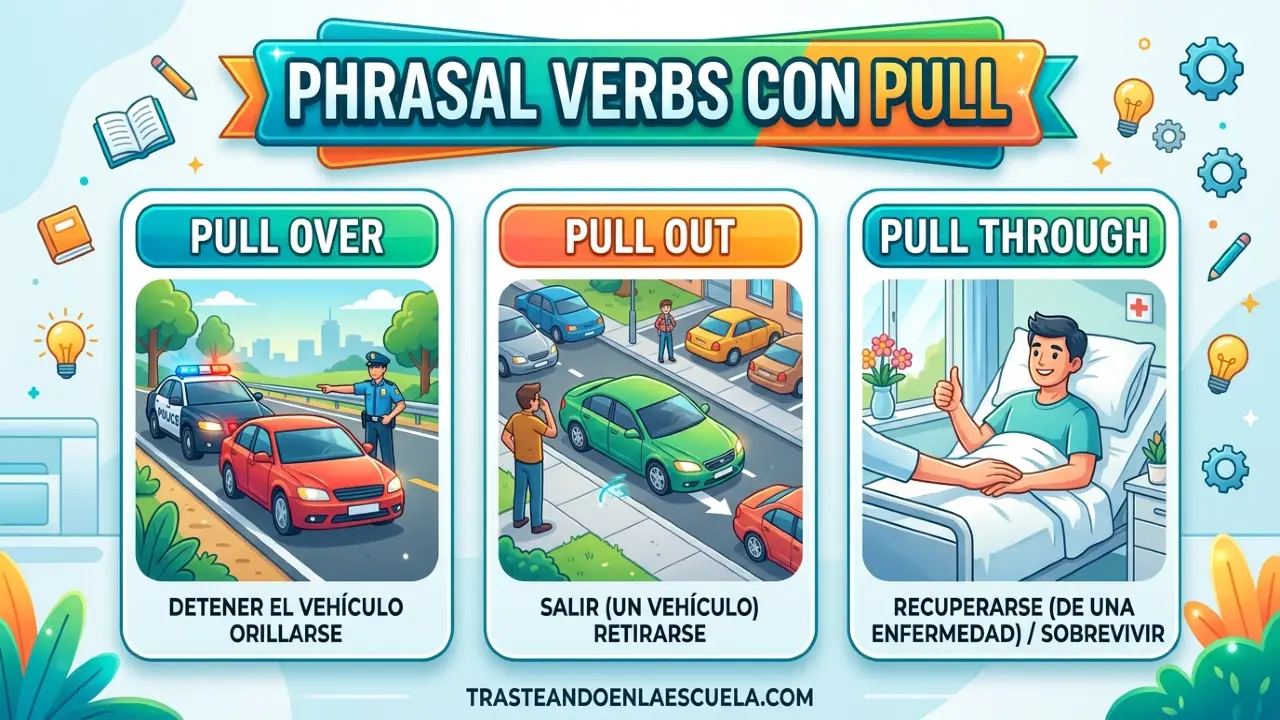
- Pull over, pull out, pull through – Phrasal verbs con PULL.
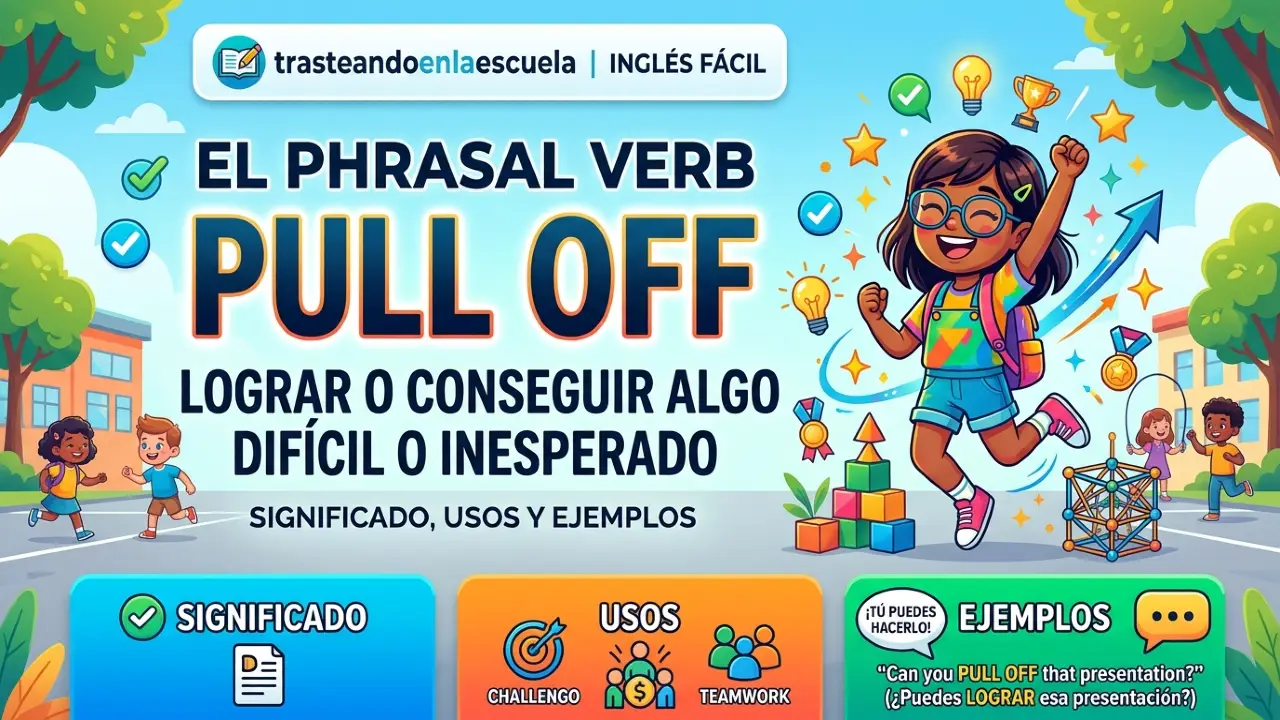
- Pull off (lograr algo difícil) – Un phrasal verb muy expresivo.
- Ejercicios phrasal verbs variados – Practica todos los phrasal verbs del cluster.
🏆 Reto final: Durante esta semana, intenta usar «carry on», «carry out» y «carry over» al menos una vez cada día. Por ejemplo, escribe tus tareas pendientes en inglés: «I need to carry out the report», «Let’s carry on with the project», «The unfinished task will carry over to Monday». ¡La práctica constante es la clave para internalizar los phrasal verbs!





Publicar comentario