Go on, go off, go out: significados, diferencias y ejemplos
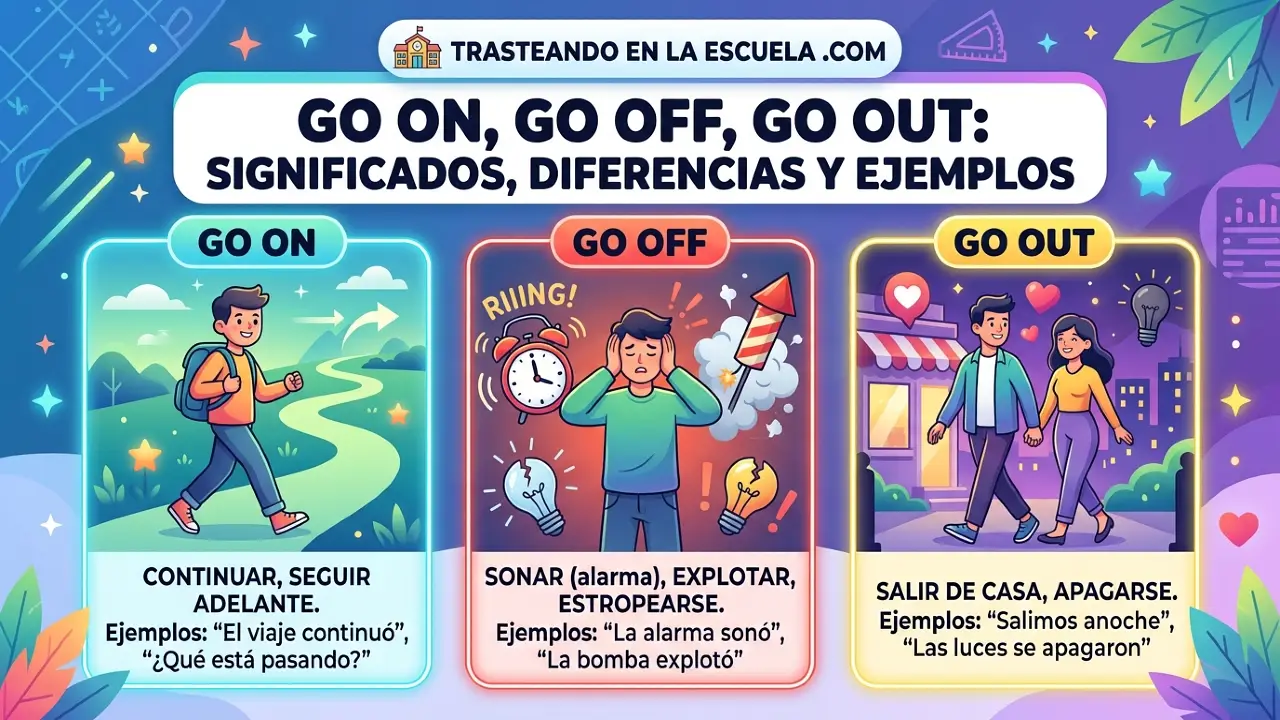
Go on, go off, go out: los phrasal verbs que todo estudiante debe dominar
Los phrasal verbs con go son de los más versátiles del inglés, y go on, go off y go out encabezan la lista de los más utilizados. ¿Sabías que go on puede significar «ocurrir», «continuar» o «encenderse»? ¿Y que go off puede referirse a una alarma que suena, comida que se estropea o una explosión? En esta guía completa aprenderás todos los significados, las estructuras gramaticales, más de 30 ejemplos prácticos y 5 ejercicios para que los uses con confianza.
🎯 En este post aprenderás: Los múltiples significados de go on, go off y go out, cómo diferenciarlos en contexto, errores comunes que debes evitar y aplicaciones reales en conversaciones cotidianas, trabajo y exámenes.
🔍 ¿Por qué son tan importantes estos tres phrasal verbs?
Go on, go off y go out aparecen constantemente en el inglés hablado y escrito. Un nativo los usa varias veces al día sin pensar. Dominarlos te permitirá entender series como Friends o The Office sin subtítulos, y sonar más natural en tus conversaciones. Además, son frecuentes en los exámenes de Cambridge (B2 First, C1 Advanced) y en el IELTS.
💡 La clave: Cada partícula (on, off, out) aporta un matiz específico. On sugiere continuidad o activación, off indica separación, finalización o activación súbita, y out implica salida o extinción. Con esta idea base será más fácil recordar sus usos.
📖 Go on: significados, estructura y ejemplos
▶️ GO ON (inseparable)
Estructura: go on + (sin objeto o con gerundio/to + infinitivo)
Significados principales:
- 1. Ocurrir o pasar: preguntar qué sucede o describir un evento.
- 2. Continuar haciendo algo: seguir con una acción, historia o actividad.
- 3. Encenderse (luces, aparatos): comenzar a funcionar.
- 4. Empezar a funcionar (energía, sistema): activarse.
- 5. Hablar sin parar (coloquial): a veces con connotación negativa.
📌 Ejemplos detallados:
- What’s going on outside? There’s a lot of noise. → ¿Qué está pasando afuera? Hay mucho ruido.
- Please go on with your story; I’m listening. → Por favor continúa con tu historia; estoy escuchando.
- Suddenly, all the lights went on in the stadium. → De repente, todas las luces se encendieron en el estadio.
- He went on talking for two hours without stopping. → Siguió hablando durante dos horas sin parar.
- After the break, the show went on as planned. → Después del descanso, el espectáculo continuó como estaba planeado.
📖 Go off: significados, estructura y ejemplos
⏰ GO OFF (inseparable)
Estructura: go off (sin objeto o con objeto indirecto en contexto)
Significados principales:
- 1. Sonar (alarma, despertador, teléfono): emitir un sonido repentino.
- 2. Estropearse (comida, bebida): echarse a perder, ponerse mala.
- 3. Explotar (bomba, petardo): detonar.
- 4. Irse o marcharse (de un lugar): salir, a menudo de forma repentina.
- 5. Dejar de gustar o perder interés: perder el entusiasmo por algo (menos común).
📌 Ejemplos detallados:
- My alarm didn’t go off this morning, so I was late for work. → Mi alarma no sonó esta mañana, así que llegué tarde al trabajo.
- This milk smells bad. I think it has gone off. → Esta leche huele mal. Creo que se ha estropeado.
- The bomb went off in the city center, but nobody was injured. → La bomba explotó en el centro de la ciudad, pero nadie resultó herido.
- He went off without saying goodbye. → Se fue sin despedirse.
- I used to love heavy metal, but I’ve gone off it recently. → Solía amar el heavy metal, pero últimamente me ha dejado de gustar.
📖 Go out: significados, estructura y ejemplos
🌙 GO OUT (inseparable)
Estructura: go out (sin objeto o con objeto: go out with someone)
Significados principales:
- 1. Salir para socializar o divertirse: ir a restaurantes, bares, cine, etc.
- 2. Apagarse (luz, fuego, dispositivo): dejar de funcionar o emitir luz.
- 3. Ser emitido o difundido: noticias, programas de televisión, información.
- 4. Salir con alguien (relación romántica): tener una cita o noviazgo.
- 5. Dejar de ser popular o estar de moda: volverse obsoleto.
📌 Ejemplos detallados:
- Let’s go out for dinner tonight. I know a great Italian place. → Salgamos a cenar esta noche. Conozco un gran lugar italiano.
- Suddenly, all the lights went out during the storm. → De repente, todas las luces se apagaron durante la tormenta.
- The news went out on all major channels. → La noticia se emitió en todos los canales importantes.
- Are you going out with anyone at the moment? → ¿Estás saliendo con alguien en este momento?
- That fashion style went out years ago. → Ese estilo de moda pasó de moda hace años.
⚖️ Tabla comparativa: diferencias clave
| Phrasal verb | Idea central | Significados principales | Ejemplo rápido |
|---|---|---|---|
| go on | continuidad / activación | ocurrir, continuar, encenderse | What’s going on? |
| go off | activación súbita / deterioro | sonar, estropearse, explotar, irse | The alarm went off. |
| go out | salida / extinción | salir, apagarse, emitirse, ser difundido | Let’s go out. |
🌍 Aplicaciones en contextos reales
🗣️ En conversaciones cotidianas
- A: What’s going on? B: Nothing much. Do you want to go out later?
- My alarm goes off at 7 a.m. every day, but today it didn’t.
- The power went out during the movie, so we couldn’t finish it.
- Please go on with your explanation; I didn’t mean to interrupt.
💼 En el entorno laboral
- We need to see what’s going on with the server; it’s down again.
- The meeting will go on even if the CEO is late.
- The emergency alarm went off during the drill.
- The report went out to all clients this morning.
📺 En series y películas
- Friends: “What’s going on with you two?”
- Stranger Things: “The lights went out again.”
- The Office: “The fire alarm went off and we had to evacuate.”
⚠️ Errores comunes y cómo evitarlos
| Error frecuente | Explicación | Corrección |
|---|---|---|
| Confundir go on con go in | What’s going in? no tiene sentido en este contexto. | What’s going on? ✅ |
| Usar go out para «salir de un edificio» sin contexto social | I went out of the office suena extraño; mejor I left. | I left the office. ✅ |
| Decir the milk went out en lugar de went off | Go out no significa estropearse. | The milk went off. ✅ |
| Usar go on para una alarma | Las alarmas siempre go off, no go on. | The alarm went off. ✅ |
🧪 5 ejercicios prácticos
📝 Ejercicio 1: Completa con go on, go off o go out
- What’s ______________? Why is everyone laughing?
- My alarm clock ______________ at 6:30 every morning.
- Let’s ______________ for a walk. It’s a beautiful day.
- Please ______________ with your presentation. We’re all listening.
- The lights suddenly ______________ during the thunderstorm.
✅ Ver soluciones
📝 Ejercicio 2: Elige la opción correcta
- This bread smells strange. I think it has gone on / gone off / gone out.
- The bomb went on / went off / went out at 10 a.m.
- Are you going on / going off / going out with anyone from work?
- The show must go on / go off / go out even if there are technical problems.
- All the news channels went on / went off / went out the story immediately.
✅ Ver soluciones
📝 Ejercicio 3: Traduce al inglés
- ¿Qué está pasando? Hay mucho ruido en la calle.
- Mi despertador no sonó esta mañana.
- Salgamos a cenar esta noche.
- La leche se ha estropeado porque la dejamos fuera de la nevera.
- Por favor continúa con tu historia.
✅ Ver soluciones
b) My alarm didn’t go off this morning.
c) Let’s go out for dinner tonight.
d) The milk has gone off because we left it out of the fridge.
e) Please go on with your story.
📝 Ejercicio 4: Identifica el significado
Escribe qué significa cada phrasal verb en la frase:
- The alarm went off at 5 a.m.
- What’s going on with the new project?
- We went out for pizza after the movie.
- The lights went out and we were in complete darkness.
- He went on talking for an hour without stopping.
✅ Ver soluciones
b) está pasando / ocurriendo
c) salimos a comer fuera
d) se apagaron
e) continuó hablando
📝 Ejercicio 5: Escribe una frase original con cada phrasal verb
- go on (significado: continuar): ______________
- go off (significado: sonar, alarma): ______________
- go out (significado: salir a socializar): ______________
- go off (significado: estropearse, comida): ______________
- go on (significado: ocurrir): ______________
✅ Ver ejemplos de respuestas válidas
b) My phone alarm goes off at 7 every day.
c) We go out for dinner every Friday.
d) The yogurt has gone off; don’t eat it.
e) What’s going on in the kitchen?
📚 Serie completa: Phrasal verbs con GO
- Go on, go off, go out — ¡Estás aquí!
- Go through, go over, go ahead: diferencias y ejemplos
- Go up, go down, go back: movimientos y cambios
- Go for vs go with: la diferencia que marca tu nivel
- Descarga la lista completa de 40 phrasal verbs con GO (PDF)
🔗 Otros recursos recomendados
🏆 Reto final: Durante los próximos 3 días, usa go on, go off y go out al menos dos veces al día en conversaciones reales o escritas. Escucha canciones en inglés y anota cada vez que los escuches. ¡Verás cómo se vuelven naturales!












Publicar comentario