Look at, look for, look after: diferencias y ejemplos
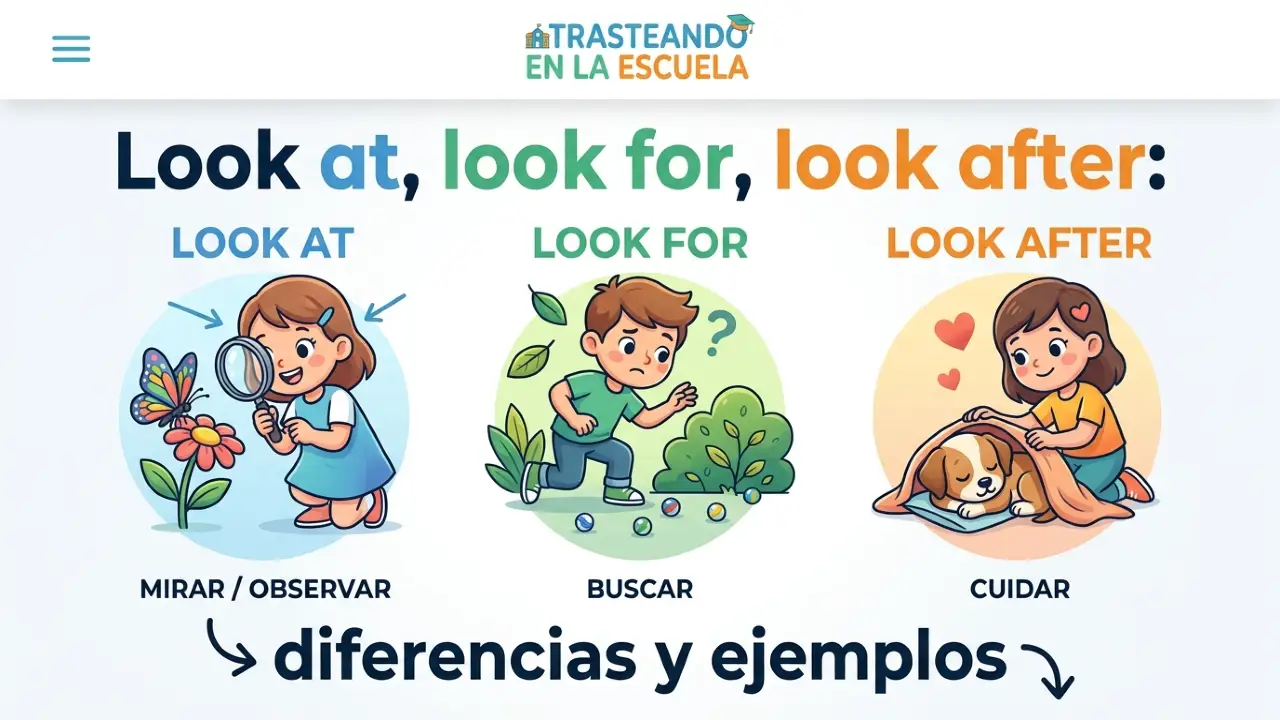
Look at, look for, look after: ¿Cuál usar?
El verbo «look» cambia completamente de significado según la preposición que le acompañe. En español usamos palabras diferentes para cada caso: mirar, buscar y cuidar. En inglés, con un mismo verbo pero distintas preposiciones, expresamos estas tres ideas.
🎯 En este post aprenderás: La diferencia clave entre look at, look for y look after, ejemplos en contexto, expresiones relacionadas, ejercicios prácticos y trucos para no confundirlos.
🔍 Visión general: Los 3 usos de LOOK + preposición
LOOK AT
Significado: Mirar (dirigir la vista)
Preposición: AT (hacia algo concreto)
Ejemplo: Look at this! (¡Mira esto!)
En español: MIRAR
LOOK FOR
Significado: Buscar (intentar encontrar)
Preposición: FOR (en busca de)
Ejemplo: I’m looking for my keys. (Busco mis llaves.)
En español: BUSCAR
LOOK AFTER
Significado: Cuidar (ocuparse de alguien/algo)
Preposición: AFTER (detrás de, cuidado)
Ejemplo: She looks after her little brother. (Cuida a su hermanito.)
En español: CUIDAR
1️⃣ LOOK AT: Mirar (dirigir la vista)
👁️ LOOK AT = Dirigir la mirada hacia algo/alguien
Usamos look at cuando queremos decir que alguien dirige su atención visual hacia un objeto, persona o lugar específico. Es el más literal de los tres.
LOOK AT + objeto (lo que miramos)
Ejemplos cotidianos de LOOK AT
- Look at the board, please. (Mirad la pizarra, por favor.)
- She was looking at herself in the mirror. (Se estaba mirando en el espejo.)
- Look at this photo! Isn’t it beautiful? (¡Mira esta foto! ¿No es preciosa?)
- Stop looking at me like that. (Deja de mirarme así.)
- He looked at his watch and realized he was late. (Miró su reloj y se dio cuenta de que llegaba tarde.)
💡 Truco: «Look at» es lo que haces cuando alguien te dice «¡Mira!» y señala algo. Es acción visual directa.
Expresiones comunes con LOOK AT
| Expresión | Significado | Ejemplo |
|---|---|---|
| Look at the time! | ¡Mira la hora! (expresa sorpresa por lo tarde que es) | Look at the time! We’re going to miss the train. |
| Look at that! | ¡Mira eso! (admiración o sorpresa) | Look at that beautiful sunset! |
| Look at you! | ¡Mírate! (orgullo o admiración) | Look at you! You’ve grown so much! |
| Not much to look at | No ser muy atractivo visualmente | The town isn’t much to look at, but it’s charming. |
2️⃣ LOOK FOR: Buscar (intentar encontrar)
🔍 LOOK FOR = Intentar encontrar algo/alguien
Look for significa buscar algo que hemos perdido o que necesitamos encontrar. La preposición «for» indica el objetivo de la búsqueda. ¡Cuidado! En español es «buscar» (sin preposición), pero en inglés siempre lleva «for».
LOOK FOR + objeto (lo que buscamos)
Ejemplos cotidianos de LOOK FOR
- I’m looking for my phone. Have you seen it? (Estoy buscando mi móvil. ¿Lo has visto?)
- She’s looking for a new job. (Está buscando un nuevo trabajo.)
- What are you looking for? (¿Qué estás buscando?)
- We’re looking for a hotel near the beach. (Buscamos un hotel cerca de la playa.)
- The police are looking for the missing child. (La policía busca al niño desaparecido.)
💡 Truco: «Look for» = «buscar» en español. Si puedes sustituirlo por «buscar» en tu frase, la opción correcta es look for.
Expresiones comunes con LOOK FOR
| Expresión | Significado | Ejemplo |
|---|---|---|
| Look for trouble | Buscar problemas | Don’t go there alone at night. You’re looking for trouble. |
| Look for a needle in a haystack | Buscar una aguja en un pajar | Finding my earring on the beach is like looking for a needle in a haystack. |
| Look for signs | Buscar señales/indicios | The doctor looked for signs of infection. |
| Look for an opportunity | Buscar una oportunidad | He’s always looking for business opportunities. |
3️⃣ LOOK AFTER: Cuidar (ocuparse de)
🤱 LOOK AFTER = Cuidar, ocuparse de alguien/algo
Look after significa cuidar, proteger o ocuparse de alguien o algo. Implica responsabilidad y atención continua. Puede referirse a personas, animales o cosas.
LOOK AFTER + objeto (persona/cosa que cuidamos)
Ejemplos cotidianos de LOOK AFTER
- Can you look after my cat while I’m on vacation? (¿Puedes cuidar de mi gato mientras estoy de vacaciones?)
- She looks after her elderly mother. (Cuida de su anciana madre.)
- We need to look after the environment. (Necesitamos cuidar el medio ambiente.)
- Who’s going to look after the children? (¿Quién va a cuidar a los niños?)
- He looks after the finances in our company. (Él se ocupa de las finanzas en nuestra empresa.)
💡 Truco: «Look after» = «cuidar» en español. Si puedes decir «cuidar de», la opción correcta es look after.
Expresiones comunes con LOOK AFTER
| Expresión | Significado | Ejemplo |
|---|---|---|
| Look after yourself | Cuídate (despedida) | Take care and look after yourself! |
| Look after your health | Cuidar la salud | You should look after your health more. |
| Look after the pennies | Cuidar el dinero (ahorrar) | If you look after the pennies, the pounds will look after themselves. |
| Look after someone’s interests | Proteger los intereses de alguien | A good lawyer looks after his client’s interests. |
📊 Comparación directa
| Frase | Significado | ¿Qué ocurre? |
|---|---|---|
| I looked at the baby. | Miré al bebé. | Solo dirigí la vista hacia él. |
| I looked for the baby. | Busqué al bebé. | Intentaba encontrarlo (quizás se había perdido). |
| I looked after the baby. | Cuidé al bebé. | Me ocupé de él durante un tiempo. |
🎯 Diagrama visual
LOOK AT → Dirección visual 👁️ → «¡Mira allí!»
LOOK FOR → Búsqueda 🔍 → «¿Dónde está?»
LOOK AFTER → Cuidado continuo 🤱 → «Me ocupo de»
⚠️ Errores comunes
| Error típico | Forma correcta | Explicación |
|---|---|---|
| «I’m looking my keys.» | I’m looking for my keys. | «Buscar» en inglés siempre lleva «for». |
| «Look the board.» | Look at the board. | «Look» sin preposición no lleva objeto directo. |
| «She looks her grandmother.» | She looks after her grandmother. | «Cuidar» requiere «after». |
| «I’m looking at my keys.» | Depende del contexto: si los ves, es correcto; si los buscas, no. | «Look at» es mirar (verlos), «look for» es buscar (no verlos). |
🧪 5 Ejercicios prácticos
Ejercicio 1: Elige la opción correcta
Completa con look at / look for / look after:
- _____ this painting. Isn’t it amazing?
- I’m _____ my passport. I can’t find it anywhere.
- My sister _____ my plants when I’m away.
- Don’t _____ me like that! It’s creepy.
- We’re _____ a new apartment in the city center.
✅ Ver soluciones
- Look at this painting. (Mirar)
- I’m looking for my passport. (Buscar)
- My sister looks after my plants. (Cuidar)
- Don’t look at me like that! (Mirar)
- We’re looking for a new apartment. (Buscar)
Ejercicio 2: Traduce al inglés
- Mira esa nube. Parece un conejo.
- ¿Puedes cuidar de mi perro este fin de semana?
- Llevo dos horas buscando mis gafas.
- Deja de mirarme y ayúdame.
- Los abuelos cuidan a los niños por la tarde.
✅ Ver soluciones
- Look at that cloud. It looks like a rabbit.
- Can you look after my dog this weekend?
- I’ve been looking for my glasses for two hours.
- Stop looking at me and help me.
- The grandparents look after the children in the afternoon.
Ejercicio 3: Completa las frases con la preposición correcta
Usa at, for, after según corresponda:
- Look _____ this document and tell me what you think.
- I’ve been looking _____ you everywhere!
- Who will look _____ the cat while we’re away?
- Look _____ the stars! They’re so bright tonight.
- She’s looking _____ a new challenge in her career.
✅ Ver soluciones
- Look at this document.
- I’ve been looking for you everywhere!
- Who will look after the cat?
- Look at the stars!
- She’s looking for a new challenge.
Ejercicio 4: Elige la opción correcta según el contexto
Selecciona A, B o C:
- I don’t know where my phone is. I need to _____ it.
A) look at B) look for C) look after - The teacher said: «_____ the board and repeat.»
A) look at B) look for C) look after - My grandmother is 90, so my mother _____ her.
A) looks at B) looks for C) looks after - _____ that man. He’s acting suspiciously.
A) look at B) look for C) look after - I’m _____ my keys. Have you seen them?
A) looking at B) looking for C) looking after



Publicar comentario