Think about vs think of: diferencias clave
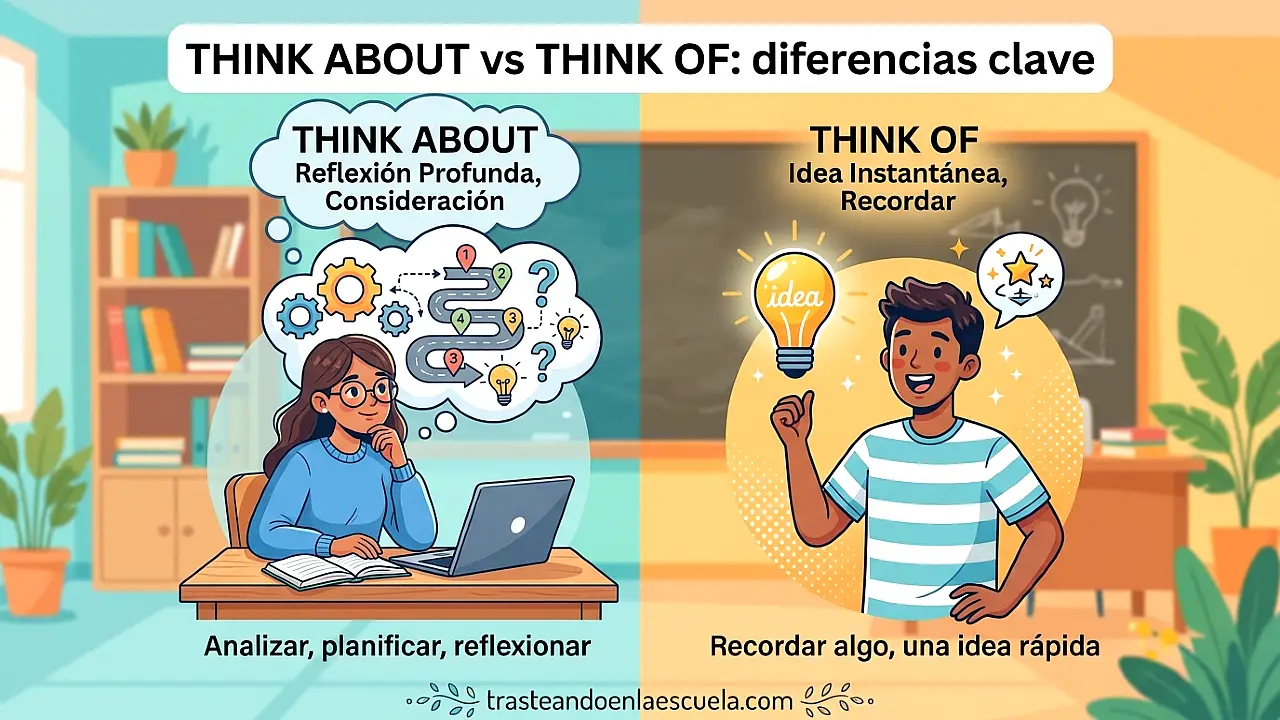
Think about vs think of: El dilema resuelto
¿Cuándo se usa «think about» y cuándo «think of»? Es una de las preguntas más frecuentes entre estudiantes de inglés. Aunque a veces son intercambiables, en muchos contextos tienen significados distintos. En esta guía te desvelamos todas las claves.
🎯 En este post aprenderás: La diferencia fundamental entre estas dos expresiones, cuándo usar cada una, ejemplos de contextos donde NO son intercambiables, y ejercicios para practicar. Si necesitas repasar la teoría general, visita nuestra lista completa de verbos con preposiciones.
🔍 La diferencia fundamental
💭 THINK ABOUT
Significado principal: Considerar, reflexionar, dedicar tiempo mental a algo.
Idea clave: Proceso, duración, análisis.
Ejemplo: «I’m thinking about changing jobs.»
✨ THINK OF
Significado principal: Tener una idea, recordar, opinar.
Idea clave: Momento puntual, reacción, creatividad.
Ejemplo: «I just thought of a great idea!»
💡 Regla de oro: Si puedes sustituirlo por «reflexionar sobre» o «considerar», usa «think about». Si puedes sustituirlo por «ocurrírsele a uno», «recordar» o «opinar sobre», usa «think of».
💭 Think about: Reflexión y consideración
Uso principal: Usamos «think about» cuando dedicamos tiempo a considerar algo, cuando estamos en un proceso de reflexión. Implica un pensamiento más profundo y duradero.
Ejemplos de «THINK ABOUT»
- I’m thinking about moving to London. (Estoy pensando en mudarme a Londres. – Es una decisión que estoy considerando.)
- She spent hours thinking about the problem. (Pasó horas pensando en el problema. – Proceso de reflexión.)
- What are you thinking about? You look worried. (¿En qué estás pensando? Pareces preocupado. – Pregunta abierta sobre el contenido del pensamiento.)
- We need to think about the consequences. (Necesitamos pensar en las consecuencias. – Analizar, considerar.)
- I’ll think about it and let you know. (Lo pensaré y te diré. – Necesito tiempo para considerar.)
✨ Think of: Opinión, recuerdo e ideas repentinas
Usos principales: «Think of» tiene tres usos muy concretos que no pueden sustituirse por «think about»:
- Opinión: «What do you think of…?» (¿Qué opinas de…?)
- Recordar/Imaginar: «I can’t think of his name.» (No recuerdo su nombre.)
- Ocurrirse una idea: «I’ve just thought of a solution.» (Acabo de pensar en una solución.)
Ejemplos de «THINK OF»
- Opinión: What do you think of my new haircut? (¿Qué opinas de mi nuevo corte de pelo?)
- Opinión: I don’t think much of that movie. (Esa película no me gusta mucho / no pienso muy bien de ella.)
- Recordar: I can’t think of her name right now. (Ahora mismo no recuerdo su nombre.)
- Idea repentina: He thought of a brilliant plan. (Se le ocurrió un plan brillante.)
- Imaginación: Think of a number between 1 and 10. (Piensa un número del 1 al 10.)
- Consideración hacia alguien: It was very kind of you to think of me. (Fue muy amable de tu parte acordarte de mí / pensar en mí.)
📊 Comparación directa
| Think about | Think of | |
|---|---|---|
| Tomar una decisión | I’m thinking about buying a car. (Estoy considerando comprarlo.) | I thought of buying a car. (Se me ocurrió, pero no implica que lo vaya a hacer.) |
| Preguntar una opinión | (No se usa para pedir opinión) | What do you think of this song? (¿Qué te parece esta canción?) |
| Recordar algo | (No se usa para recordar) | I can’t think of his address. (No recuerdo su dirección.) |
| Preocupación | I’m thinking about you. (Me preocupo por ti, estoy pendiente de ti.) | I thought of you. (Me acordé de ti.) |
| Futuro/Planes | We’re thinking about going to Italy. (Estamos planeando ir.) | We thought of going to Italy. (Se nos ocurrió, pero quizás no vayamos.) |
❌ ¿Cuándo NO son intercambiables?
Aunque a veces pueden usarse indistintamente (especialmente en el pasado con «never» o «often»), hay contextos donde SOLO uno es correcto.
Casos donde SOLO «think of» es correcto:
- Para preguntar opinión: What do you think of the new teacher?
- Para ideas repentinas: I’ve just thought of something important.
- Para «recordar»: I can’t think of the word in English.
- Con «imagine»: Think of a world without war.
Casos donde SOLO «think about» es correcto:
- Cuando implica reflexión profunda: I need to think about this carefully.
- Cuando va seguido de gerundio (-ing) con sentido de plan: I’m thinking about studying medicine.
🧠 Ejercicios prácticos
Ejercicio 1: Completa con about u of
- What do you think _____ the new boss?
- I’m thinking _____ going to the beach this weekend.
- I just thought _____ a great way to solve this.
- She never thinks _____ other people’s feelings.
- I can’t think _____ his phone number.
- We need to think _____ the future.
- He thought _____ me when he saw the gift.
- What are you thinking _____? – Nothing special.
✅ Ver soluciones
1. of | 2. about | 3. of | 4. about | 5. of | 6. about | 7. of | 8. about
Ejercicio 2: Elige la opción más adecuada
- I’m thinking about / thinking of buying a new phone. I’ve been comparing models for weeks.
- What do you think about / think of this dress? Does it suit me?
- I thought about / thought of you yesterday when I saw your favourite band on TV.
- I can’t decide. Let me think about / think of it for a day.
- She thought about / thought of a brilliant idea in the shower.
- Don’t worry, I’m thinking about / thinking of you. (preocuparse)
✅ Ver soluciones
1. thinking about (proceso de reflexión) | 2. think of (opinión) | 3. thought of (recordar, acordarse) | 4. think about (considerar) | 5. thought of (idea repentina) | 6. thinking about (preocuparse)
Ejercicio 3: Traduce al inglés
- ¿Qué piensas de mi nuevo coche?
- Estoy pensando en cambiar de trabajo.
- Acabo de pensar en una solución.
- No recuerdo su nombre.
- Pensaré en tu oferta y te llamaré.
- ¿En qué piensas? – En nada.
- Ella siempre piensa en los demás.
- Me acordé de ti cuando vi esto.
✅ Ver soluciones
1. What do you think of my new car? | 2. I’m thinking about changing jobs. | 3. I’ve just thought of a solution. | 4. I can’t think of his name. | 5. I’ll think about your offer and call you. | 6. What are you thinking about? – Nothing. | 7. She always thinks about others. | 8. I thought of you when I saw this.
Ejercicio 4: Completa el texto
Yesterday, I was _______________ (think about/of) my future. I’m _______________ (think about/of) studying abroad next year. I _______________ (think about/of) it a lot lately. My mother asked me: «What do you _______________ (think about/of) this idea?» I told her I needed to _______________ (think about/of) it carefully. Then, suddenly, I _______________ (think about/of) a problem: I don’t have enough money. I need to _______________ (think about/of) ways to save more. But then I _______________ (think about/of) a scholarship. Maybe that’s the solution!
✅ Ver soluciones
thinking about, thinking about, ‘ve been thinking about, think of, think about, thought of, think about, thought of
Ejercicio 5: Preguntas para reflexionar
Responde con frases completas, usando think about u of según corresponda:
- What do you think of social media?
- What are you thinking about right now?
- Can you think of a famous person you admire?
- What are you thinking about doing next weekend?
- Think of a place you’d love to visit. Where is it?
(Respuesta libre. Practica diciendo las frases en voz alta.)
📖 Recursos relacionados
📚 Serie completa: Preposiciones después de Verbos
- Verbs + prepositions: lista completa – El post general con todas las combinaciones.
- Look at, look for, look after: diferencias – Domina los phrasal verbs con «look».
- Wait for, ask for, pay for: usos y ejemplos – Verbos comunes con «for».
- Think about vs think of: diferencias clave – ¡Estás aquí!
- Ejercicios verbos + preposiciones – Pon a prueba todo lo que has aprendido.







Publicar comentario