Turn out: significado, usos y ejemplos del phrasal verb «resultar»
Turn out: El phrasal verb de los resultados inesperados
¿Alguna vez has planeado algo que resultó ser completamente diferente a lo que esperabas? ¿O has ido a un evento y has visto cuánta gente asistió? El phrasal verb turn out es tu mejor aliado para hablar de resultados finales, sorpresas, descubrimientos y asistencia. Es uno de los phrasal verbs más versátiles con turn y aparece constantemente en conversaciones cotidianas, noticias e historias.
🎯 En este post aprenderás: Los tres significados principales de turn out (resultar, descubrirse, asistir), sus estructuras gramaticales, diferencias con otros phrasal verbs como turn up o turn into, más de 30 ejemplos, errores comunes y 5 ejercicios para dominarlo por completo.
🔍 ¿Qué significa exactamente turn out?
🎯 El verbo del resultado final
Turn out tiene tres significados principales que debes conocer:
1. RESULTAR – Cómo termina algo (a menudo inesperado)
2. DESCUBRIRSE / RESULTAR QUE – Revelación de información
3. ASISTIR / ACUDIR – Número de personas que van a un evento
🎬 La analogía del director de cine
Imagina que eres director de cine. Has rodado una película con actores, efectos especiales y una historia. Pero no sabes cómo va a turn out (resultar) hasta que la ves terminada. Puede turn out to be un éxito o un fracaso. Al estreno, quieres saber cuánta gente turns out (asiste) al cine. Y durante el rodaje, puedes descubrir que algo turns out to be falso. Turn out captura esa incertidumbre hasta el final.
📋 Significado 1: Resultar (cómo termina algo)
🎯 Estructura: turn out + adjetivo / bien / mal
Este es el uso más común. Turn out describe el resultado final de una situación, a menudo contrastando con lo esperado.
- Don’t worry, everything will turn out fine. (No te preocupes, todo saldrá bien.)
- The party turned out to be a disaster. (La fiesta resultó ser un desastre.)
- How did your exam turn out? (¿Cómo te resultó el examen? / ¿Cómo te fue?)
- The cake turned out delicious. (El pastel resultó delicioso.)
- Their marriage turned out badly. (Su matrimonio resultó mal.)
🎯 Estructura: turn out to be + sustantivo/adjetivo
Con to be, se enfatiza la identidad o cualidad final de algo o alguien.
- He turned out to be a liar. (Resultó ser un mentiroso.)
- The weather turned out to be sunny after all. (El clima resultó ser soleado después de todo.)
- She turned out to be the best candidate. (Resultó ser la mejor candidata.)
- What turned out to be a small problem became a crisis. (Lo que resultó ser un pequeño problema se convirtió en una crisis.)
💡 Diferencia con «end up»: Turn out se usa más para resultados de eventos o situaciones. End up se usa más para decisiones o caminos personales. The movie turned out great. vs I ended up staying home.
📋 Significado 2: Descubrirse, resultar que (revelación)
🎯 Estructura: It turns out that… / As it turns out…
Este uso es muy común para introducir información que se descubre o que contradice lo que se creía. Es como decir «resulta que» en español.
- It turns out that he was never really sick. (Resulta que nunca estuvo realmente enfermo.)
- As it turns out, we went to the same high school. (Resulta que fuimos a la misma secundaria.)
- It turned out that the treasure was buried in the garden. (Resultó que el tesoro estaba enterrado en el jardín.)
- She thought she had lost her phone, but it turned out she had left it in the car. (Pensó que había perdido el teléfono, pero resultó que lo había dejado en el coche.)
🎯 Ejemplos en conversación
- I thought he was angry, but it turned out he was just tired.
- We expected a quiet evening, but as it turned out, the whole neighborhood came over.
- It turns out that coffee is good for your liver. (Estudio científico reciente)
📋 Significado 3: Asistir, acudir (a un evento)
🎯 Estructura: turn out + (número) + for / to
Este significado se refiere a la cantidad de personas que asisten a un evento. Es muy usado en noticias, informes y conversaciones sobre eventos.
- A lot of people turned out for the concert. (Mucha gente acudió al concierto.)
- Over 10,000 fans turned out to see the band. (Más de 10,000 fans asistieron para ver a la banda.)
- Why didn’t more voters turn out for the election? (¿Por qué no acudieron más votantes a las elecciones?)
- The whole town turned out for the parade. (Todo el pueblo salió al desfile.)
🎯 Sustantivo relacionado: turnout
El sustantivo turnout (una sola palabra) significa «asistencia» o «afluencia».
- The turnout was higher than expected. (La asistencia fue mayor de lo esperado.)
- Low voter turnout is a problem in many countries. (La baja participación electoral es un problema en muchos países.)
📊 Tabla comparativa: Los 3 significados
| Significado | Estructura | Ejemplo |
|---|---|---|
| Resultar (cómo termina) | turn out + adjetivo / bien/mal | Everything turned out fine. |
| Resultar ser (identidad) | turn out to be + sustantivo/adjetivo | He turned out to be a hero. |
| Descubrirse (revelación) | It turns out that… | It turns out that she was right. |
| Asistir, acudir | turn out + for / to + evento | Thousands turned out for the rally. |
🔄 Turn out vs otros phrasal verbs con turn
🎲 TURN OUT
Resultado final – cómo termina algo.
The movie turned out to be boring.
🎯 TURN INTO
Transformación – cambio de una cosa a otra.
The caterpillar turned into a butterfly.
🔍 TURN UP
Aparecer – llegar a un lugar (similar al significado 3 de turn out, pero menos formal y sin énfasis en cantidad).
He turned up late.
💡 Diferencia clave: turn out vs turn up para asistencia
Ambos pueden significar «asistir», pero turn out se usa más con números y eventos formales (prensa, informes). Turn up es más informal y se usa para personas individuales: 20,000 people turned out for the protest vs My brother turned up at my door.
🎯 Estructura gramatical: ¿Es separable?
📌 Turn out es inseparable (generalmente)
Turn out es un phrasal verb inseparable cuando significa «resultar» o «descubrirse». No se puede separar el verbo de la partícula. Con el significado de «asistir», también es inseparable.
The party turned out well.
It turned out that he was lying.
Many people turned out for the event.
❌ Incorrecto:
The party turned well out. (NO)
Turned it out that he was lying. (NO)
Excepción: Cuando turn out significa «apagar una luz» (uso menos común), entonces es separable: Turn out the lights / Turn the lights out. Pero este uso es anticuado o británico; hoy se prefiere turn off.
🌟 Expresiones idiomáticas con turn out
✨ Frases comunes
- Turn out all right / OK – salir bien al final
Don’t panic; everything will turn out all right. - Turn out for the best – resultar para bien
Losing that job turned out for the best. - As it turned out – al final resultó que…
As it turned out, we didn’t need to worry. - It remains to be seen how things turn out – está por verse cómo resultan las cosas.
🧪 5 Ejercicios prácticos
Ejercicio 1: Completa con turn out en la forma correcta
Usa turn out en el tiempo verbal adecuado.
- Don’t worry, everything __________ fine in the end.
- The cake looked terrible, but it __________ delicious.
- How did the meeting __________ ?
- Her prediction __________ to be completely wrong.
- I hope the weather __________ nice for the picnic.
✅ Ver solución
- will turn out – futuro (esperanza)
- turned out – pasado (ya ocurrió)
- turn out – presente/pasado según contexto, aquí «did the meeting turn out» es pasado
- turned out – pasado
- turns out – presente simple o «will turn out» – ambos posibles
Ejercicio 2: Elige el significado correcto
Indica si turn out significa «resultar», «descubrirse» o «asistir».
- Over 5,000 people turned out for the marathon.
- It turns out that I had met him before.
- The experiment turned out to be a success.
- What time did you turn out for the meeting? (contexto: asistencia)
- As it turned out, the tickets were free.
✅ Ver solución
- asistir – número de personas en un evento
- descubrirse – revelación de información
- resultar – resultado final del experimento
- asistir – cuándo llegaste / asististe
- descubrirse – se descubrió que las entradas eran gratis
Ejercicio 3: Reescribe usando turn out + to be o it turns out that
Transforma las oraciones usando turn out.
- He was actually a very kind person. (resultó ser)
- The solution was simpler than we thought. (resultó que)
- She wasn’t lying after all. (resulta que)
- The restaurant was surprisingly cheap. (resultó ser)
- Nobody knew the answer. (resultó que)
✅ Ver solución
- He turned out to be a very kind person.
- It turned out that the solution was simpler than we thought.
- It turns out that she wasn’t lying after all.
- The restaurant turned out to be surprisingly cheap.
- It turned out that nobody knew the answer.
Ejercicio 4: Traduce al inglés usando turn out
- Todo salió bien al final.
- Resultó que el ladrón era el mayordomo.
- ¿Cuánta gente acudió a la manifestación?
- La película resultó ser aburridísima.
- Resulta que no necesitábamos llevar paraguas.
✅ Ver solución
- Everything turned out fine in the end.
- It turned out that the thief was the butler.
- How many people turned out for the protest?
- The movie turned out to be very boring.
- It turns out that we didn’t need to bring umbrellas.
Ejercicio 5: Crea oraciones originales
Escribe una oración con turn out para cada situación:
- Un resultado positivo después de una preocupación
- Un descubrimiento sorprendente sobre alguien
- La asistencia a un evento (con número)
- Una situación que resultó ser diferente a lo esperado
- Una revelación sobre algo del pasado
✅ Ver soluciones de ejemplo
- Positivo: I was nervous about the interview, but everything turned out great.
- Sorprendente: My quiet neighbor turned out to be a famous musician.
- Asistencia: More than 2,000 people turned out for the charity run.
- Diferente: The hotel turned out to be much nicer than the photos showed.
- Revelación pasada: It turned out that my grandparents had met in that very café.
❌ Errores comunes con turn out
| Error | Ejemplo incorrecto | Corrección | Explicación |
|---|---|---|---|
| Olvidar «to be» con adjetivo | He turned out intelligent. | He turned out to be intelligent. | Con adjetivos que describen cualidades, se necesita «to be». |
| Confundir con «turn up» para asistencia | 10,000 people turned up for the concert. | 10,000 people turned out for the concert. | Turn out es más formal y común con cifras; turn up es más informal. |
| Usar «turn out» sin objeto en «asistir» | Many people turned out. (incompleto) | Many people turned out for the event. | Con el significado de asistir, especifica para qué evento. |
| Separar el phrasal verb | Turned it out that he was lying. | It turned out that he was lying. | Turn out es inseparable en estos significados. |
🌍 Aplicaciones en la vida real
📰 En noticias y medios
- Voter turnout was at an all-time low.
- The missing child turned out to be safe at a friend’s house.
- Thousands turned out for the annual pride parade.
🗣️ En conversaciones cotidianas
- How did your job interview turn out?
- It turns out we have a lot in common.
- Don’t worry, things always turn out for the best.
📝 En escritura académica y profesional
- The results turned out to be statistically significant.
- As it turned out, the initial hypothesis was incorrect.
- Turnout for the training session was disappointing.
📚 Serie completa: Phrasal verbs con TURN
Continúa aprendiendo todos los phrasal verbs con turn:
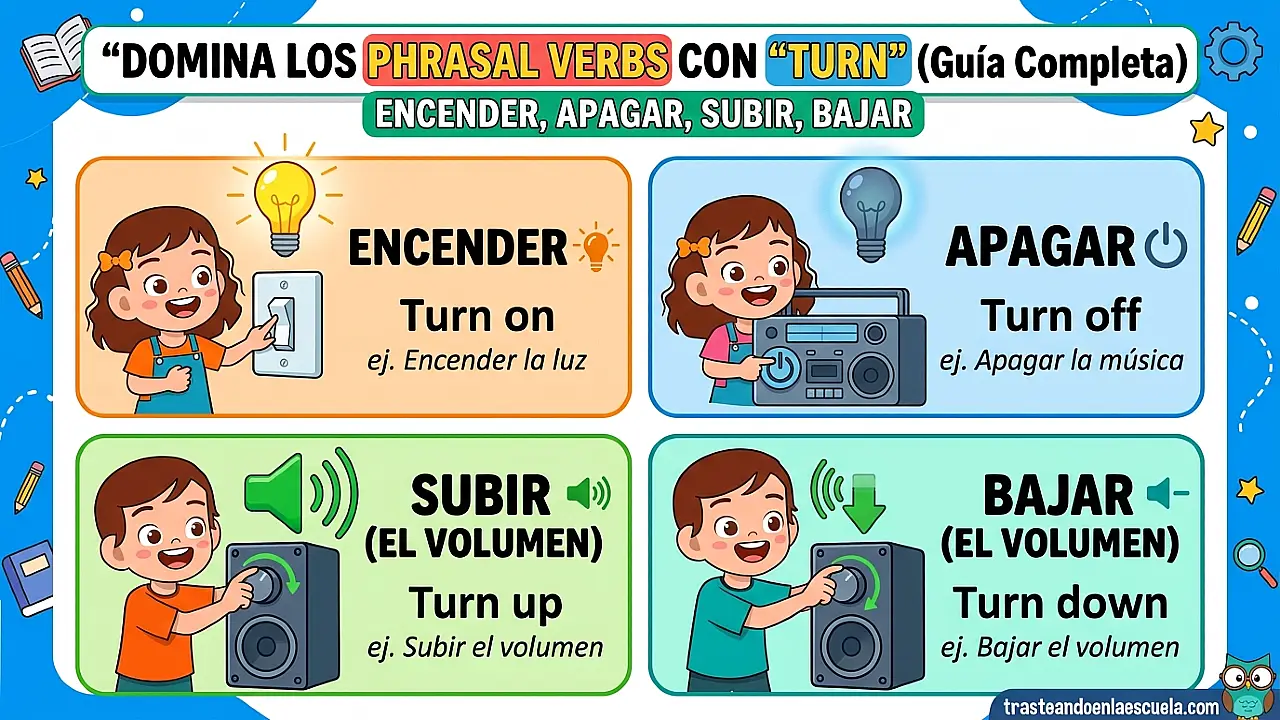
- Turn on, off, up, down – Controles y ajustes básicos.
- Turn into (convertirse en) – Transformaciones y cambios.
- Turn around, back, over – Movimiento y dirección.
- Turn out (resultar) – ¡Estás aquí! Resultados y sorpresas.
- 25 phrasal verbs con TURN (lista PDF) – Descarga la guía completa.
🎯 Reto de la semana: Cada día, escribe una frase usando turn out sobre algo que haya ocurrido ese día. Por ejemplo: My coffee turned out too strong today. o It turns out that my favorite show is on Netflix. Al final de la semana, tendrás 7 ejemplos reales que reflejan tu vida. ¡Compártelos con alguien que esté aprendiendo inglés!












Publicar comentario